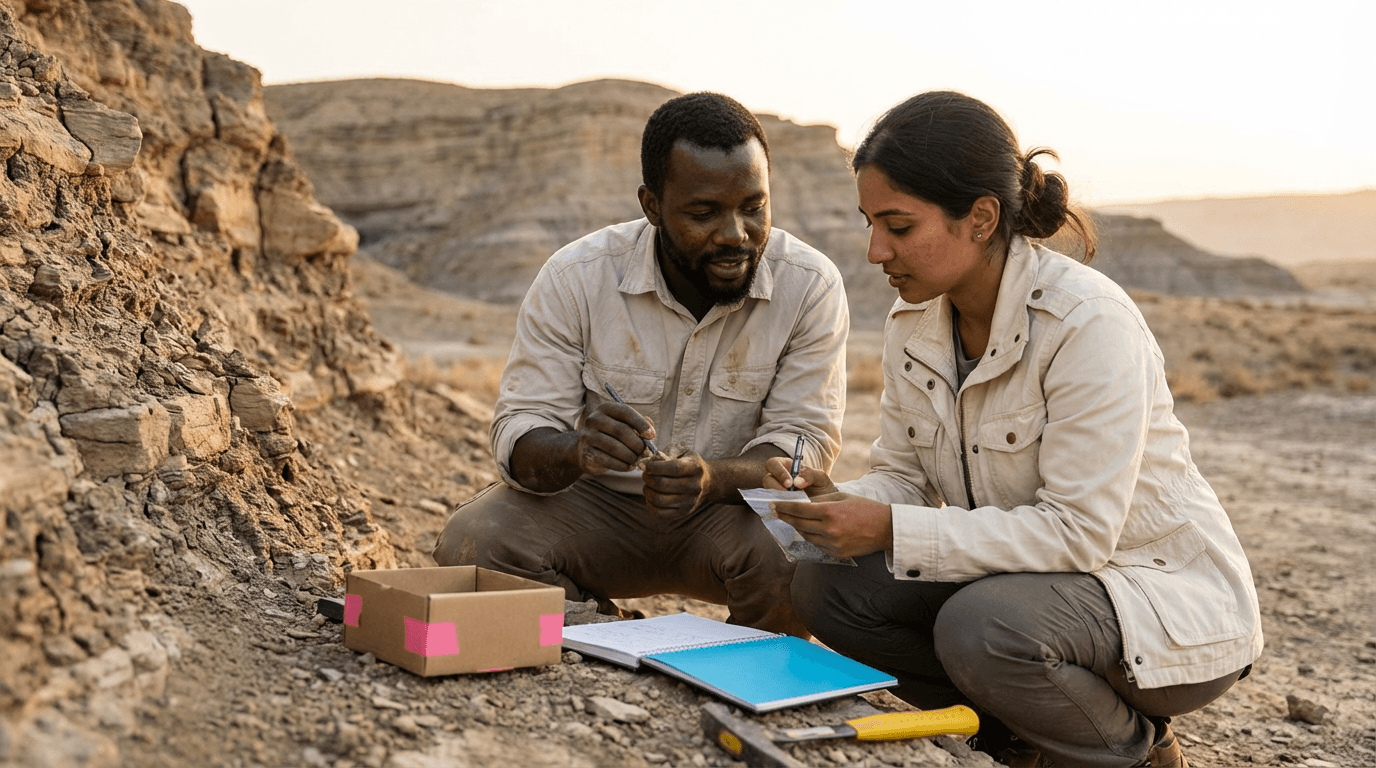
Lesson 1Cross-validation and multi-method strategies: choosing primary and backup methods, integrating stratigraphic constraints and biostratigraphyWe talk about planning multiple dating methods, picking main and extra ones, adding layer and fossil limits, fixing mismatched ages, and making strong timelines with clear error notes.
Criteria for choosing primary methodsSelecting complementary backup techniquesIntegrating stratigraphy and biostratigraphyReconciling discordant or outlier agesChronological models and uncertainty budgetsLesson 2Common laboratory and field errors across methods: contamination, reworking, diagenesis, inheritance, open-system behavior, and analytical uncertaintiesWe review usual problems in the field and lab that mess up ages, like dirt mixing, moved materials, chemical changes, carried-over old bits, open systems, machine issues, and math errors, with ways to spot, fix, and control quality.
Sampling bias, mixing and reworkingContamination and modern carbon inputsDiagenesis, alteration and resettingInheritance and detrital grain complicationsAnalytical uncertainties and QA/QCLesson 3Fission-track and (U-Th)/He thermochronology: apatite and zircon for cooling histories, track annealing, effective temperature ranges, sample selectionWe introduce track counting and helium methods in apatite and zircon for cooling stories, how tracks fade, helium moves, closing temps, picking samples, spread in ages, and modeling cooling and uplift paths.
Spontaneous fission tracks and etching methodsTrack annealing, kinetics and partial zones(U-Th)/He diffusion and closure conceptsMineral selection and radiation damage effectsThermal history and exhumation modelingLesson 4Radiocarbon (C-14): materials dated, calibration, reservoir effects, upper limit ~50 kaWe discuss how C-14 is made, decays, and measured, good organic and some inorganic materials, cleaning steps, calibration lines, effects from water bodies, age up to about 50,000 years, and reading probability graphs after calibration.
14C production, decay law and measurementDatable materials and sample pretreatmentCalibration curves and calendar agesMarine and freshwater reservoir effectsLimits, background and contamination controlLesson 5Luminescence dating (OSL/IRSL/TL): dating feldspar and quartz in sediments, burial dose measurement, sample handling to avoid light exposure, age ranges and dose rate estimationWe introduce dating quartz and feldspar in sediments using light, explaining trapped charges, measuring dose from burial, taking samples in the dark, calculating dose rates, age limits, and fixing issues like full signal use or fading.
Trapped charge physics and luminescence signalsOSL, IRSL and TL measurement protocolsField sampling and light-safe handlingDose rate components and environmental dosimetryAge calculation, limits and fading correctionsLesson 6Radioisotopic dating fundamentals: parent-daughter systems, half-life, closure temperature, isochronsWe cover the main ideas of radioisotope dating, like parent to daughter decay, half-life times, decay speeds, when rocks stop letting elements move, making isochron lines, fixing starting daughter amounts, and checking for open systems and measurement errors.
Radioactive decay equations and half-lifeParent–daughter systems and mineral hostsClosure temperature and diffusion effectsIsochron theory and data regressionAssessing open-system behavior and errorsLesson 7Paleomagnetism as an auxiliary absolute/relative tool: polarity stratigraphy correlation, sampling procedures, secular variation curvesWe show how old magnetism in rocks gives age clues through matching magnetic flips in layers and changes over time. We talk about how to take samples, clean magnetic signals, match to known magnetic timelines, and combine with direct dating and layer orders.
Remanent magnetization carriers and typesField sampling strategies and orientationLaboratory demagnetization and componentsPolarity stratigraphy and GPTS correlationSecular variation curves and age modelingLesson 8Potassium-Argon and Argon-Argon (K-Ar, Ar-Ar): minerals suitable (whole-rock basalt, sanidine, groundmass, plagioclase), age ranges, sample preparation, excess argon issuesWe look closely at K–Ar and 40Ar/39Ar methods, the best minerals and rocks for them, how to irradiate and heat samples step by step, age spectra, problems with extra or old argon, checking for changes in rocks, and suitable time ranges from new lava flows to very old volcanic and changed rocks.
40K decay scheme and argon retentionSuitable minerals and rock typesIrradiation, flux monitors and standardsAge spectra, plateaus and isochronsExcess argon, recoil and alteration testsLesson 9U-Pb in zircon and baddeleyite: applications to granitoids, ash/tuff, concordia diagrams, Pb loss and inheritanceWe explain U–Pb dating using zircon and baddeleyite, how U and Pb get into them, concordia diagrams, why dates might not match, Pb loss, old material carried over, fixing common Pb problems, and uses for granite rocks, dark intrusions, and ash or tuff from volcanoes.
U and Pb partitioning in accessory mineralsID-TIMS, LA-ICP-MS and SIMS approachesConcordia, discordia and age interpretationPb loss, metamorphism and inheritanceApplications to plutons and ash layers