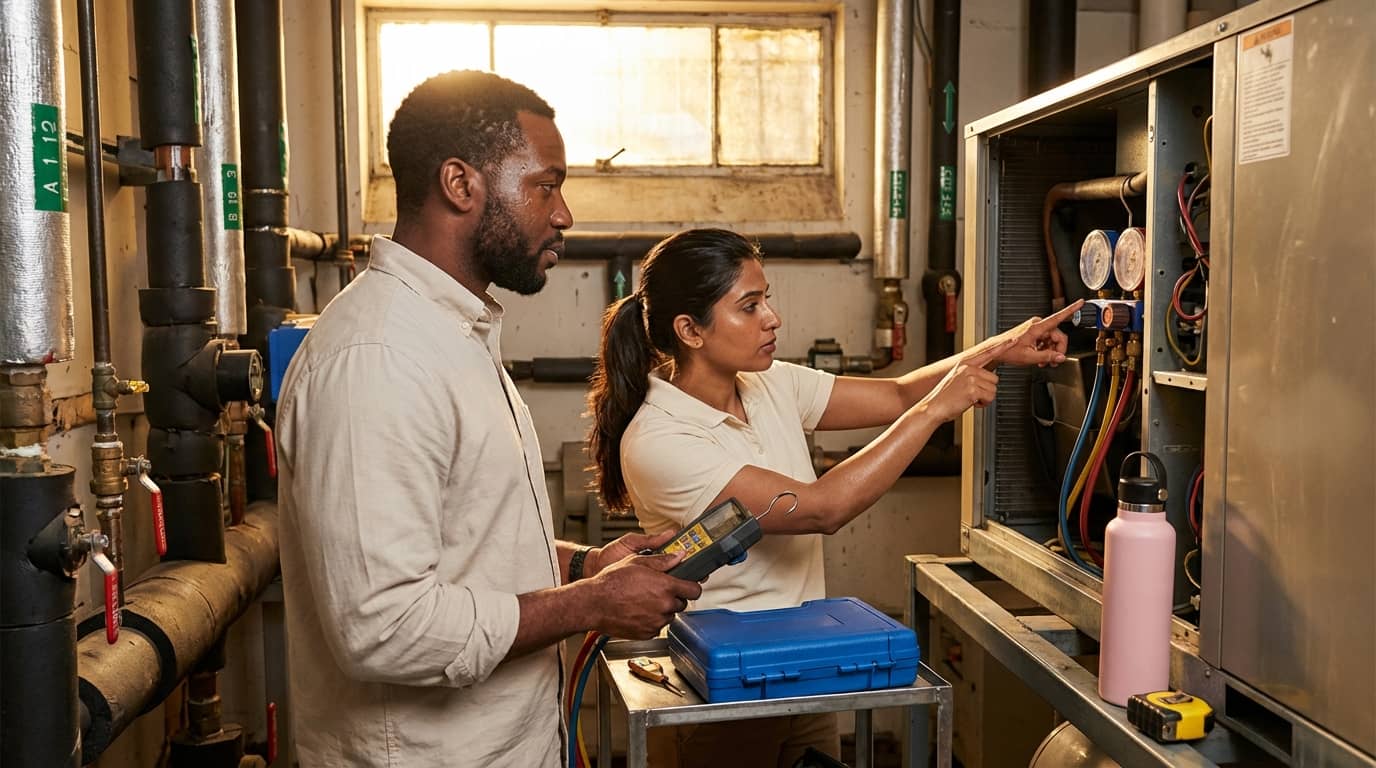
Lesson 1Fundamentals of heat transfer for HVAC loads: sensible vs latent, conduction, convection, radiation, and solar gainsThis lesson review heat transfer fundamentals for HVAC loads, distinguishing sensible and latent heat, and describing conduction, convection, radiation, and solar gains as they apply to building envelopes and internal sources in hot weather.
Sensible versus latent heat definitionsConduction through building assembliesConvection at interior and exterior surfacesLongwave and shortwave radiation effectsSolar gains and their interaction with loadsLesson 2Solar heat gain calculations: orientation, shading factors, glass properties, and use of solar heat gain coefficientsThis lesson cover how solar gains enter through glazing, how orientation and shading modify incident radiation, and how glass properties and SHGC values are applied to estimate hourly solar cooling loads in sunny Liberia.
Solar geometry and surface orientationShading devices and shading coefficientsGlass types, coatings, and visible transmittanceUsing SHGC and area to find solar gainsTime-of-day and seasonal solar variationsLesson 3Presenting load calculation worksheets: unit conversions, consistent units (IP), and step-by-step example structureThis lesson describe how to organize and present load worksheets, maintain consistent IP units, perform key unit conversions, and structure step-by-step examples so that assumptions and intermediate results are traceable for local use.
Standard worksheet layout and sectionsConsistent IP units and common pitfallsKey unit conversions for load workDocumenting assumptions and inputsStep-by-step example presentationLesson 4Equipment and plug load calculations: inventorying, duty cycles, diversity factors, and internal heat distributionThis lesson explain how to estimate equipment and plug loads from connected power, duty cycles, and diversity, and how internal heat is split between sensible and latent components and distributed among zones in offices.
Identifying equipment and plug inventoriesConnected load, demand, and duty cycleDiversity factors for receptacle loadsSensible versus latent equipment gainsZonal distribution of internal equipment heatLesson 5Ventilation and latent loads: outdoor air sensible and latent contributions, using humidity ratios and psychrometric principlesThis lesson focus on outdoor air ventilation loads, using humidity ratios and psychrometric properties to separate sensible and latent components, and show how code-required airflow translate into cooling and dehumidification loads in humid air.
Ventilation airflow from codes and standardsOutdoor and indoor design conditionsHumidity ratio, enthalpy, and psych chartsSensible versus latent ventilation loadsPreconditioning and energy recovery impactsLesson 6Infiltration and unbalanced ventilation: estimating infiltration rates, impact on latent and sensible loadsThis lesson explain how uncontrolled air leakage and unbalanced ventilation affect sensible and latent loads, methods to estimate infiltration rates, and how stack, wind, and mechanical effects are reflected in load calculations for windy days.
Drivers of infiltration: wind and stackACH, CFM, and envelope leakage metricsEstimating infiltration for load designSensible and latent load from infiltrationUnbalanced ventilation and pressure effectsLesson 7Latent load estimation and psychrometrics: dew point, specific humidity, calculation of latent heat loads from people, ventilation, and processesThis lesson develop latent load estimation using psychrometrics, covering dew point, specific humidity, and how to compute latent heat from people, ventilation air, and moisture-generating processes in buildings like ours.
Dew point, humidity ratio, and RHPsychrometric chart navigation basicsLatent gains from occupantsLatent loads from ventilation airProcess moisture sources and dehumidificationLesson 8Load calculation approaches: manual cooling load calculations, heat balance overview, and simplified methodsThis lesson introduce major cooling and heating load calculation approaches, including detailed manual methods, heat balance concepts, and simplified rules of thumb, highlighting accuracy, inputs, and typical use cases for quick designs.
Design objectives and required accuracyManual component-by-component methodsHeat balance and radiant-time-series ideasSimplified and rule-of-thumb approachesComparing methods and selecting an approachLesson 9People load calculations: sensible and latent contributions per occupant and per area, using ASHRAE tablesThis lesson detail how to quantify sensible and latent heat from occupants using ASHRAE tables, considering activity level, clothing, and occupancy schedules, and how to convert people loads to area-based design values for crowded spaces.
Metabolic rates and activity categoriesASHRAE tables for sensible and latent gainsOccupancy density and diversity factorsSchedules and peak occupancy selectionConverting per-person to per-area loadsLesson 10Combining loads and safety factors: coincident load summation, diversity, temperature delta selections, and peak load extrapolation from one floor to whole buildingThis lesson show how to combine component loads into system design loads, apply diversity and safety factors, select indoor and outdoor design temperature deltas, and extrapolate floor-level results to whole-building peaks in multi-story buildings.
Coincident versus noncoincident load summationApplying diversity to internal gainsChoosing indoor and outdoor design deltasSafety factors and avoiding oversizingScaling floor loads to whole buildingsLesson 11Envelope heat gains: conduction through walls, roof, windows using UA method and solar heat gain through glazingThis lesson cover envelope heat gains through walls, roofs, and windows using the UA method, including temperature differences, solar-exposed surfaces, and how conduction and solar gains combine in glazing assemblies under strong sun.
U-values, R-values, and UA calculationsWall and roof conduction with design deltasWindow conduction and frame effectsSolar gains through glazing systemsThermal mass and time lag considerationsLesson 12Lighting load calculations: converting lighting power density to sensible heat, diversity, and control impactsThis lesson explain how to convert lighting power density and fixture data into sensible heat gains, apply diversity and control strategies, and account for schedules, daylight dimming, and ballast or driver losses in bright rooms.
Lighting power density and fixture dataConverting watts to sensible heat gainsLighting schedules and diversity factorsControls: occupancy and daylight dimmingBallast, driver, and luminaire losses