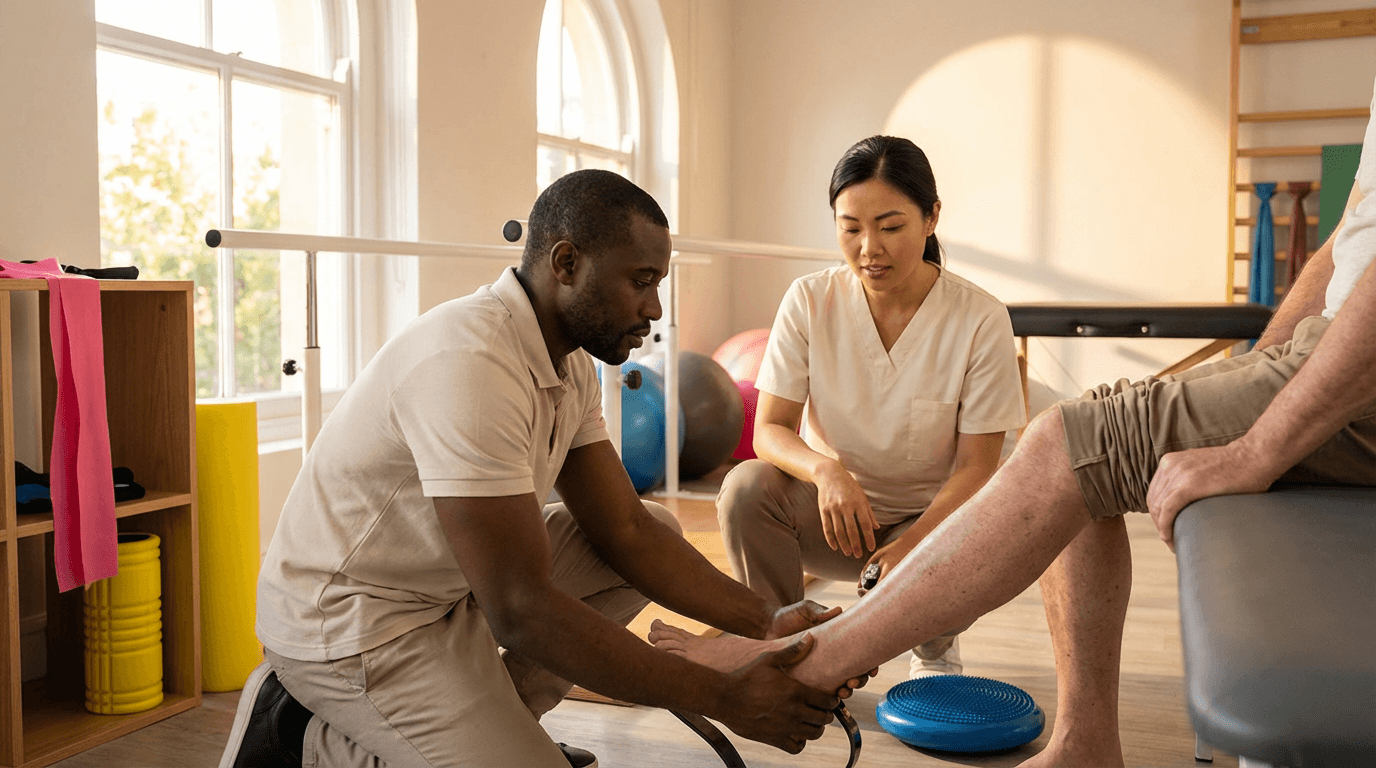
Lesson 1Remainin' limb exam: skin health, scars, neuroma signs, swellin', limb volume change an' measure waysDis part focus pon remainin' limb exam, stressin' skin check, scar movement, neuroma signs, swellin', limb volume change, an' standard measure ways to support safe loadin', socket fit choices, an' long-time tissue health fi daily comfort.
Skin color, integrity, and breakdown riskScar location, adherence, and mobility testsPalpation for neuroma and nerve tendernessEdema patterns and soft tissue consistencyCircumference and length measurement methodsMonitoring limb volume changes over timeLesson 2Function movement testin': timed up-an'-go (TUG), 6-minute walk test, stair check, sit-to-stand measuresDis part outline function movement testin' fi transtibial users, includin' TUG, 6-minute walk, stair handlin', an' sit-to-stand measures, wid guide pon test setup, safety, readin', an' recordin' change over rehab time.
Timed Up and Go test setup and scoringSix-Minute Walk Test proceduresStair ascent and descent performanceSit-to-stand and transfer assessmentsUse of assistive devices during testsLesson 3Balance an' position sense testin': clinical tests (Berg Balance Scale items, one-leg stand, Limits of Stability) an' tool measuresDis part explain balance an' position sense testin', coverin' clinical tools like Berg items, one-leg stand, an' Limits of Stability, plus optional tool measures, to measure fall risk an' guide target balance trainin' fi safety.
Static standing balance observationsBerg Balance Scale item selectionSingle-leg stance and tandem stance testsLimits of Stability and weight shiftingInstrumented balance and sway measuresLesson 4Organized history-takin': surgery history, prosthetic history, pain types, activity goals, an' mind-social factorsDis part explain how fi collect focused history fi transtibial prosthesis users, coverin' surgery details, prosthetic use, pain patterns, daily activities, joinin' goals, an' mind-social parts dat affect rehab results an' stickin' to plan.
Key surgical details and amputation etiologyPrevious prosthetic use and device changesPain type, intensity, triggers, and patternsActivity level, vocational and sport goalsPsychosocial context, mood, and supportLesson 5Joint movement range an' muscle length testin' important fi transtibial amputees (hip, knee, ankle/gastroc-soleus length)Dis part review joint movement range an' muscle length testin' important fi transtibial amputees, stressin' hip, knee, an' gastrocnemius–soleus length, shorten risk, test positions, an' meanin's fi gait an' prosthetic alignment.
Hip flexion, extension, and rotation rangeKnee flexion and extension measurementGastrocnemius–soleus length assessmentStandardized goniometry positioningImpact of contractures on gait and fitLesson 6Help device an' surroundin' check: cane/walker use, work demands, uneven ground challengesDis part address check of help devices an' surroundin's, includin' cane or walker fit, home an' work demands, community ground, an' travel needs, to ensure safe movement an' real rehab plannin' fi daily life.
Cane and walker selection and fittingHome layout, hazards, and accessibilityWorkplace physical demands and tasksCommunity terrain and outdoor challengesTransportation and public transit accessLesson 7Look an' static posture check wid prosthesis on an' off (pelvic alignment, limb length, shortenin's)Dis part cover systematic visual check wid an' widout di prosthesis, focusin' pon overall posture, pelvic alignment, limb length, shortenin's, spine curves, an' fix ways dat may affect comfort, gait ease, an' long-time joint health.
Posture with prosthesis donned and doffedPelvic tilt, obliquity, and rotation checksApparent and true limb length comparisonDetection of hip and knee flexion contracturesSpinal alignment and compensatory posturesLesson 8Muscle strength test rules fi hip abductors/extensors, knee extensors, core an' other limbDis part detail muscle strength test rules fi key muscle groups, includin' hip abductors an' extensors, knee extensors, core stabilizers, an' di other limb, usin' hand test an' strength measure to guide exercise givin'.
Hip abductor strength testing methodsHip extensor and gluteal strength checksKnee extensor and quadriceps assessmentCore stability and trunk strength testsContralateral limb strength comparisonLesson 9Gait analysis frame: look checklist (stance/swing even, step length, stance time, foot clearance), findin' prosthetic-related changesDis part show a organized gait analysis frame, usin' look checklists fi stance an' swing, step length, stance time, an' foot clearance, an' link common changes to possible prosthetic or body causes an' treatment needs.
Standardized observational gait checklistStance phase symmetry and stabilitySwing phase, foot clearance, and timingStep length and cadence comparisonsCommon transtibial gait deviationsLinking deviations to likely prosthetic causesLesson 10Prosthetic special checks: socket fit check, suspension work, pressure map basics, alignment signs, prosthetic foot response, socks/liner fit an' volume handlin'Dis part detail prosthetic special checks, includin' socket fit, suspension function, pressure spread, alignment signs, foot behavior, an' sock or liner handlin', to tell prosthetic problems from body issues in checkin'.
Static and dynamic socket fit assessmentSuspension system function and pistoningPressure-sensitive and tolerant area reviewVisual and functional alignment indicatorsFoot rollover, heel response, and stabilitySock ply, liner fit, and volume strategies