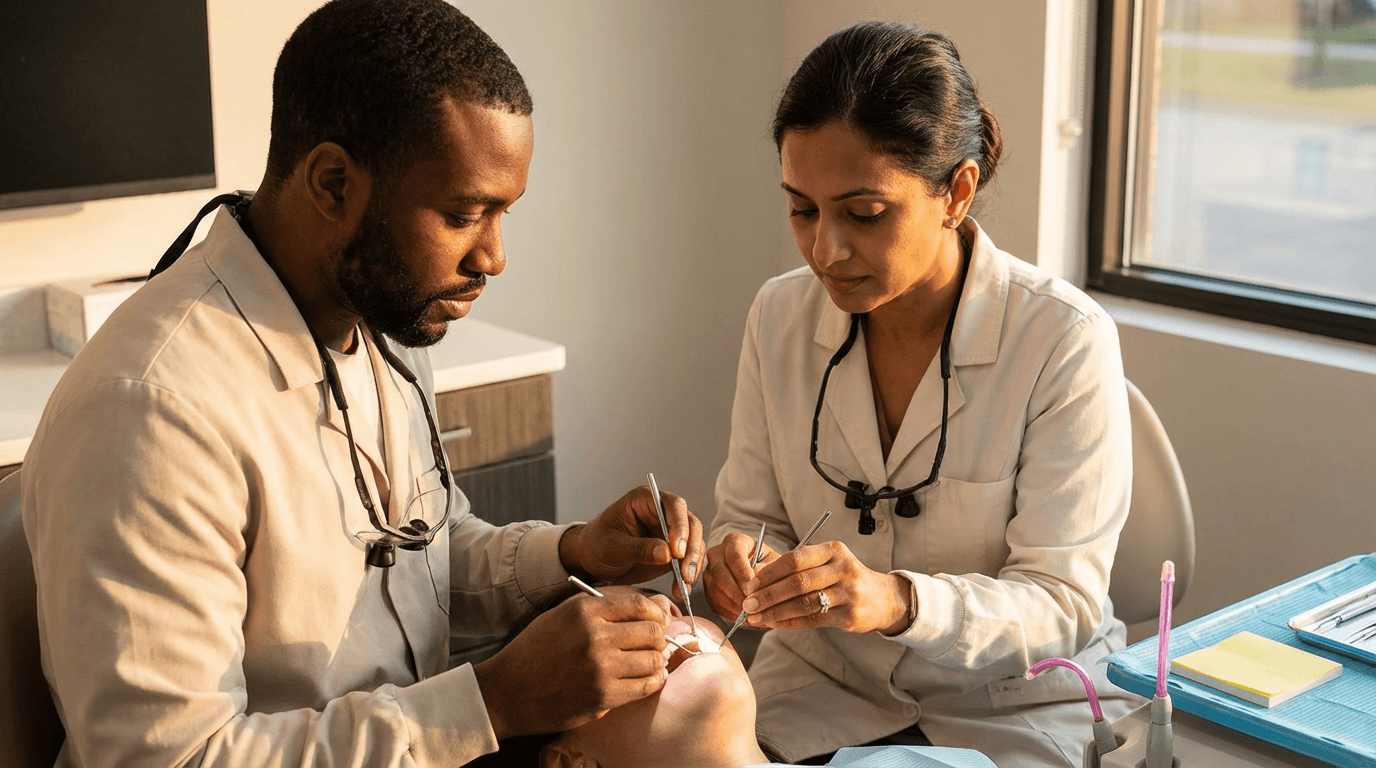
Lesson 1Interproximal finishin' durin' build: creatin' contacts, finishin' strips, an' preservin' embrasure anatomyDis section focus pon interproximal finishin' durin' veneer build-up, detailin' how fi create proper contacts, preserve embrasure form, an' use strips an' discs fi refine anatomy widout damagin' adjacent teeth or soft tissues.
Timing of contact creation during layeringUsing matrices and wedges for tight contactsFinishing strips for proximal contouringPreserving incisal and gingival embrasuresPolishing interproximal surfaces safelyLesson 2Usin' silicone indices an' matrices fi create palatal shells an' control palatal contour an' incisal lengthDis section cover fabrication an' use a silicone indices an' matrices fi guide palatal shell creation, control palatal contour an' incisal length, an' standardize veneer thickness, improvin' accuracy, repeatability, an' chairside efficiency.
Taking precise preoperative impressions or scansFabricating silicone indices from wax-upPositioning and stabilizing the palatal indexControlling palatal contour and incisal edgeTroubleshooting voids and misfit in indicesLesson 3Isolation methods an' rationale: rubber dam placement, alternative isolation techniques, an' soft-tissue managementDis section review isolation strategies fi veneer procedures, focusin' pon rubber dam placement, alternative isolation when dam use is limited, an' soft-tissue management fi maintain a dry, clean field an' protect patient comfort.
Rubber dam clamp selection and positioningPunching and placing dam for anterior veneersUse of Teflon, retraction cord, and wedgesAlternative isolation when dam is not feasibleProtecting lips, gingiva, and patient comfortLesson 4Composite selection an' layerin' strategy: selectin' universal vs. microhybrid vs. nanohybrid; opaquers, dentin body, an' enamel/translucent layersDis section guide composite selection fi veneers, comparin' universal, microhybrid, an' nanohybrid resins, an' definin' de role a opaquers, dentin, an' enamel masses fi manage value, chroma, an' translucency in layered restorations.
Criteria for universal vs microhybrid vs nanohybridShade mapping and value-driven selectionUsing opaquers to mask discolorationsChoosing dentin body and enamel massesLayer thickness to control translucencyLesson 5Polymerization strategy an' shrinkage control: incremental curin', light intensity, curin' radiometer checks, an' ambient light considerationsDis section address polymerization strategy an' shrinkage control, coverin' incremental layerin', light intensity, exposure times, radiometer checks, an' ambient light management fi ensure complete curin' an' minimize stress.
Incremental layering to reduce shrinkage stressLight-curing unit selection and maintenanceExposure times for different composite shadesUsing a radiometer to verify light outputManaging ambient light and pre-gel polymerizationLesson 6Stepwise anatomical build-up fi a central incisor: palatal shell, dentin mass, mamelon/characterization, an' final enamel layerDis section present a stepwise build-up a a maxillary central incisor veneer, from palatal shell fi dentin body, mamelons, an' final enamel layer, emphasizin' 3D anatomy, optical effects, an' controlled increments fi esthetic an' functional harmony.
Planning thickness and space for each layerCreating a stable palatal shell with compositeBuilding dentin core and primary anatomyDesigning mamelons and internal characterizationsPlacing final enamel layer and surface textureLesson 7Preparation philosophy: no-prep vs. minimal enamel bevels, finishin' a incisal edges an' interproximal adjustmentsDis section compare no-prep an' minimal-prep veneers, detailin' enamel bevel design, incisal an' interproximal adjustments, an' how fi preserve structure while creatin' space fi composite, improvin' adhesion, emergence profile, an' long-term stability.
Case selection for true no-prep veneersDesigning minimal facial and cervical bevelsManaging incisal edge shortening or lengtheningInterproximal opening vs contact preservationFinishing and polishing preparation marginsLesson 8Adhesive protocol in detail: enamel etch times, selective dentin etch, primer/bond application, an' bondin' systems recommended fi veneersDis section explain de adhesive protocol fi veneers, includin' enamel an' selective dentin etch, primer an' bondin' application, an' selection a bondin' systems, emphasizin' moisture control an' reliable long-term adhesion.
Total-etch vs selective-etch indicationsEnamel etching times and rinsing protocolSelective dentin etching and sensitivity controlPrimer and adhesive application sequenceChoosing bonding systems suited for veneersLesson 9Replication strategy fi adjacent teeth: symmetry techniques, templates, an' incremental matchin' a anatomy an' shadeDis section detail how fi replicate adjacent teeth usin' symmetry protocols, templates, an' incremental build-up, focusin' pon matchin' line angles, surface texture, an' shade gradients fi achieve natural, harmonious anterior esthetics.
Analyzing reference tooth morphology and shadeUsing silicone or putty templates for symmetryIncremental build-up to mirror contralateral toothMatching line angles and surface macrotextureFinal adjustments to value and chroma matchLesson 10Managin' minor gingival concerns intraoperatively: retraction cord, hemostasis, an' finishin' marginsDis section explain intraoperative management a minor gingival issues, focusin' pon safe retraction, predictable hemostasis, an' precise margin finishin' fi protect soft tissues, improve visibility, an' secure clean, stable bondin' areas fi veneers.
Indications for retraction cord in veneer casesCord selection, placement depth, and timingChemical hemostatic agents and application tipsAvoiding tissue trauma and recession risksFinishing margins near soft tissue safely