
Car Inspection Course
Learn to inspect every major vehicle system with confidence, from brakes and suspension to electrical components and drivetrain. This course gives you the hands-on knowledge and professional standards employers and customers expect. Whether you are starting a career or sharpening existing skills, you will finish ready to perform thorough, accurate vehicle inspections.
What you'll learn:
This course covers the complete vehicle inspection process from the ground up. You will learn how to safely use lifts, hand tools, and diagnostic scan tools to assess engine condition, brake systems, steering, suspension, tyres, and electrical components. You will also study emissions testing, hybrid and electric vehicle procedures, and fleet inspection standards. By the end, you will know how to write professional inspection reports, classify defects by urgency, and communicate findings clearly to customers. Every skill is built on real inspection procedures used in the field.
How you study in practice Car Inspection Course
How you practise Car Inspection Course
For businesses looking to train their team
With Elevify for businesses, the course includes exercises and examples tailored to your own business and the way your company needs.

Course content
8 Chapters • 39 LessonsDuration between 4 and 360 hours (you decide)
Chapter 1HideHide detailsSee detailsFoundations of Vehicle Inspection
Foundations of Vehicle Inspection
Lesson 1 • Purpose and Scope of Inspections
Covers the safety, legal, and economic rationale behind vehicle inspections. Establishes the professional context inspectors operate within.
Lesson 2 • Inspection Standards and Documentation
Introduces standardised checklists, report formats, and recordkeeping requirements. Accurate documentation is framed as a core professional obligation.
Lesson 3 • Inspector Safety and Work Environment
Addresses personal protective equipment, shop hazards, and safe vehicle positioning. Establishes habits that protect inspectors throughout all subsequent chapters.
Lesson 4 • Types of Vehicle Inspections
Distinguishes pre-purchase, periodic, roadside, and fleet inspections. Students identify which inspection type applies to a given scenario.
Chapter 2HideHide detailsSee detailsTools, Equipment, and Workspace Setup
Tools, Equipment, and Workspace Setup
Lesson 1 • Essential Hand Tools for Inspection
Covers wrenches, screwdrivers, pliers, and specialty tools used during inspections. Students match each tool to its correct inspection task.
Lesson 2 • Diagnostic Scan Tools and Software
Introduces OBD-II scanners, live data streaming, and freeze-frame analysis. Students retrieve and interpret basic fault codes as part of a complete inspection.
Lesson 3 • Lifting Equipment and Vehicle Access
Covers two-post lifts, four-post lifts, floor jacks, and jack stands. Students demonstrate safe lifting procedures before any undercarriage work.
Lesson 4 • Measuring and Testing Instruments
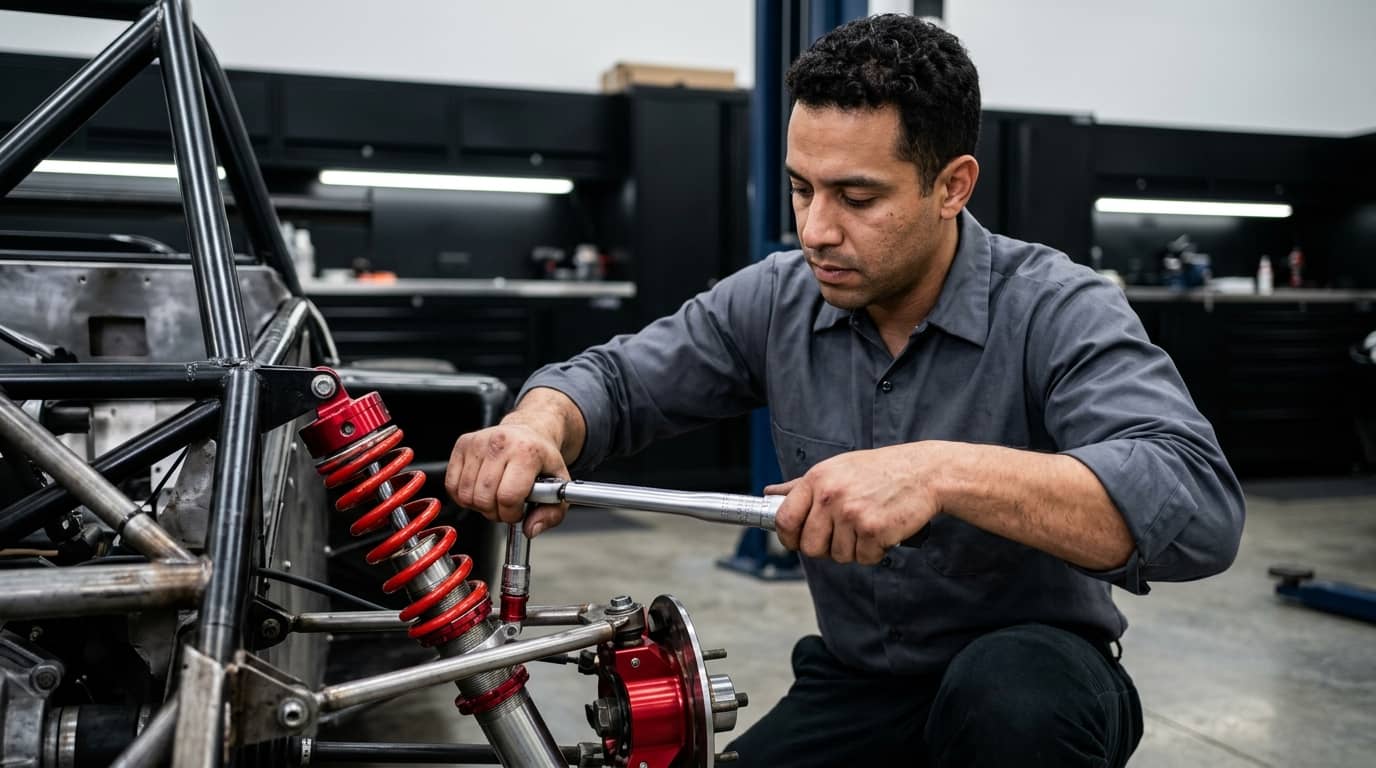
Introduces torque wrenches, calipers, tread depth gauges, and multimeters. Accurate measurement is linked directly to reliable inspection findings.
Lesson 5 • Workspace Organisation and Efficiency
Covers bay layout, tool shadowing, and workflow sequencing to minimise inspection time. An organised workspace reduces errors and improves throughput.
Chapter 3HideHide detailsSee detailsEngine and Fluid System Inspection
Engine and Fluid System Inspection
Lesson 1 • Fuel System and Air Intake Inspection
Covers fuel line integrity, filter condition, and air filter restriction. Students assess components that directly affect fuel economy and emissions.
Lesson 2 • Cooling System Inspection
Addresses coolant level, concentration, hose integrity, and radiator condition. Students use a pressure tester to detect leaks not visible to the naked eye.
Lesson 3 • Engine Oil and Lubrication System
Covers oil level, colour, viscosity, and contamination checks. Students connect oil condition findings to engine wear and maintenance intervals.
Lesson 4 • Visual Engine Compartment Assessment
Teaches systematic visual scanning of the engine bay for leaks, corrosion, and damaged components. Visual assessment is the first step before any hands-on testing.
Lesson 5 • Additional Fluid Systems Check
Covers brake fluid, power steering fluid, transmission fluid, and windscreen washer fluid. Students complete a full fluid audit as part of a comprehensive inspection.
Chapter 4HideHide detailsSee detailsBrake System Inspection
Brake System Inspection
Lesson 1 • Drum Brake Inspection Procedures
Addresses shoe lining thickness, drum diameter, wheel cylinder condition, and hardware. Students identify worn or seized components that require immediate replacement.
Lesson 2 • Disc Brake Inspection Procedures
Covers pad thickness measurement, rotor thickness and runout, and caliper condition. Students apply minimum thickness specifications to pass or fail decisions.
Lesson 3 • Hydraulic System and Master Cylinder
Covers master cylinder inspection, brake pipe condition, and ABS modulator visual checks. Students trace the hydraulic circuit to locate leaks and corrosion.
Lesson 4 • Parking Brake and Final Assessment
Tests parking brake cable tension, engagement, and holding force. Students compile brake findings into a prioritised service recommendation.
Lesson 5 • Brake System Overview and Safety
Introduces hydraulic brake principles, component relationships, and failure consequences. Understanding system function enables accurate defect interpretation.
Chapter 5HideHide detailsSee detailsSteering and Suspension Inspection
Steering and Suspension Inspection
Lesson 1 • Wheel Alignment Indicators
Teaches recognition of alignment-related tyre wear patterns and steering pull symptoms. Students recommend alignment service based on inspection evidence.
Lesson 2 • Shock Absorbers and Struts
Covers bounce test, fluid leakage, and structural damage assessment for shocks and struts. Students correlate ride control defects with braking distance and handling.
Lesson 3 • Steering System Components and Function
Introduces rack-and-pinion and recirculating-ball steering systems and their key components. Component knowledge is prerequisite to accurate wear detection.
Lesson 4 • Suspension Component Inspection
Addresses ball joint wear, control arm bushings, and sway bar links. Students distinguish normal wear from safety-critical defects requiring immediate action.
Lesson 5 • Steering Linkage Inspection
Covers tie rod end play, drag link condition, and steering gear lash. Students use a pry bar and dial indicator to quantify wear beyond acceptable limits.
Chapter 6HideHide detailsSee detailsTyres, Wheels, and Drivetrain Inspection
Tyres, Wheels, and Drivetrain Inspection
Lesson 1 • Wheel and Rim Inspection
Addresses rim cracks, bead seat damage, and wheel runout. Students identify wheel defects that compromise tyre sealing and vehicle safety.
Lesson 2 • Driveshaft and CV Joint Inspection
Addresses driveshaft balance, U-joint wear, and CV boot condition. Students detect early-stage CV joint failure before catastrophic breakdown occurs.
Lesson 3 • Wheel Bearing Inspection
Covers bearing play, noise diagnosis, and hub unit condition for both serviceable and sealed bearings. Students differentiate bearing noise from brake and tyre noise.
Lesson 4 • Tyre Condition and Safety Assessment
Covers tread depth measurement, sidewall damage, and inflation pressure checks. Students apply minimum tread depth standards to pass or fail determinations.
Lesson 5 • Differential and Transfer Case Check
Covers fluid level, leak detection, and noise assessment for differentials and transfer cases. Students complete the drivetrain inspection as a unified system review.
Chapter 7HideHide detailsSee detailsElectrical, Lighting, and Safety Systems
Electrical, Lighting, and Safety Systems
Lesson 1 • Battery and Charging System Inspection
Covers battery load testing, terminal condition, and alternator output verification. Students use a battery tester and multimeter to quantify charging system health.
Lesson 2 • Advanced Driver Assistance Systems Check
Introduces camera, radar, and sensor calibration status checks for ADAS features. Students recognise when ADAS components require specialist recalibration.
Lesson 3 • Interior Electrical and Instrument Checks
Covers dashboard warning lights, gauge accuracy, and interior lighting function. Students confirm that driver-facing information systems operate correctly.
Lesson 4 • Airbag and Restraint System Inspection
Addresses SRS warning light status, seatbelt latch and retractor function, and airbag cover condition. Students identify restraint defects without disabling live systems.
Lesson 5 • Exterior Lighting Inspection
Addresses headlight aim, bulb condition, lens clarity, and indicator function. Students verify all exterior lights meet minimum output and aim standards.
Chapter 8HideHide detailsSee detailsComplete Inspection Workflow and Reporting
Complete Inspection Workflow and Reporting
Lesson 1 • Professional Inspection Report Writing
Covers clear defect descriptions, supporting evidence, and cost-neutral language in written reports. Students produce reports that inform without pressuring customers.
Lesson 2 • Customer Communication and Follow-Up
Addresses explaining technical findings in plain language, handling objections, and scheduling follow-up. Effective communication converts inspection findings into customer trust.
Lesson 3 • Systematic Full-Vehicle Inspection Sequence
Establishes a repeatable inspection order that prevents missed items and minimises vehicle movement. Students execute the sequence within a professional time target.
Lesson 4 • Defect Classification and Prioritisation
Teaches immediate safety concern, advisory, and maintenance categories for defect classification. Students prioritise findings to guide customer repair decisions.
Lesson 5 • Road Test Procedures and Observations
Covers brake feel, steering response, gearbox shift quality, and noise identification during a structured road test. Road test findings supplement static inspection data.

Your valid completion certificate
This course is for you:
Aspiring inspectors: ready to enter the automotive trade professionally.
Auto shop technicians: wanting to add inspection services to their work.
Car enthusiasts: eager to evaluate vehicles beyond basic DIY maintenance.
Career changers: drawn to a stable, hands-on trade with real demand.
Fleet coordinators: needing structured knowledge to oversee vehicle condition.
Used car buyers: determined to assess vehicles before making costly purchases.
What our students say
Hear from those who've already studied with us:
Your lessons are perfect. I purchased the one-year package and finally have the opportunity to follow various topics of interest without needing to change platforms... I'm grateful for everything you do, I've already recommended you to other people...

I like how the lessons are straight to the point and how I can change chapters and skip content I don't need.

I like the content and the way videos are presented and transcribed, which speeds up the process!

The platform is fast and simple to use. The diversity of content and complementary videos really help with learning.

Top upskilling courses




FAQ
Who is Elevify? How does it work?
Do the courses have certificates?
Are the courses free?
What is the course workload?
What are the courses like?
How do the courses work?
What is the duration of the courses?
What is the cost or price of the courses?
What is an EAD or online course and how does it work?
PDF Course