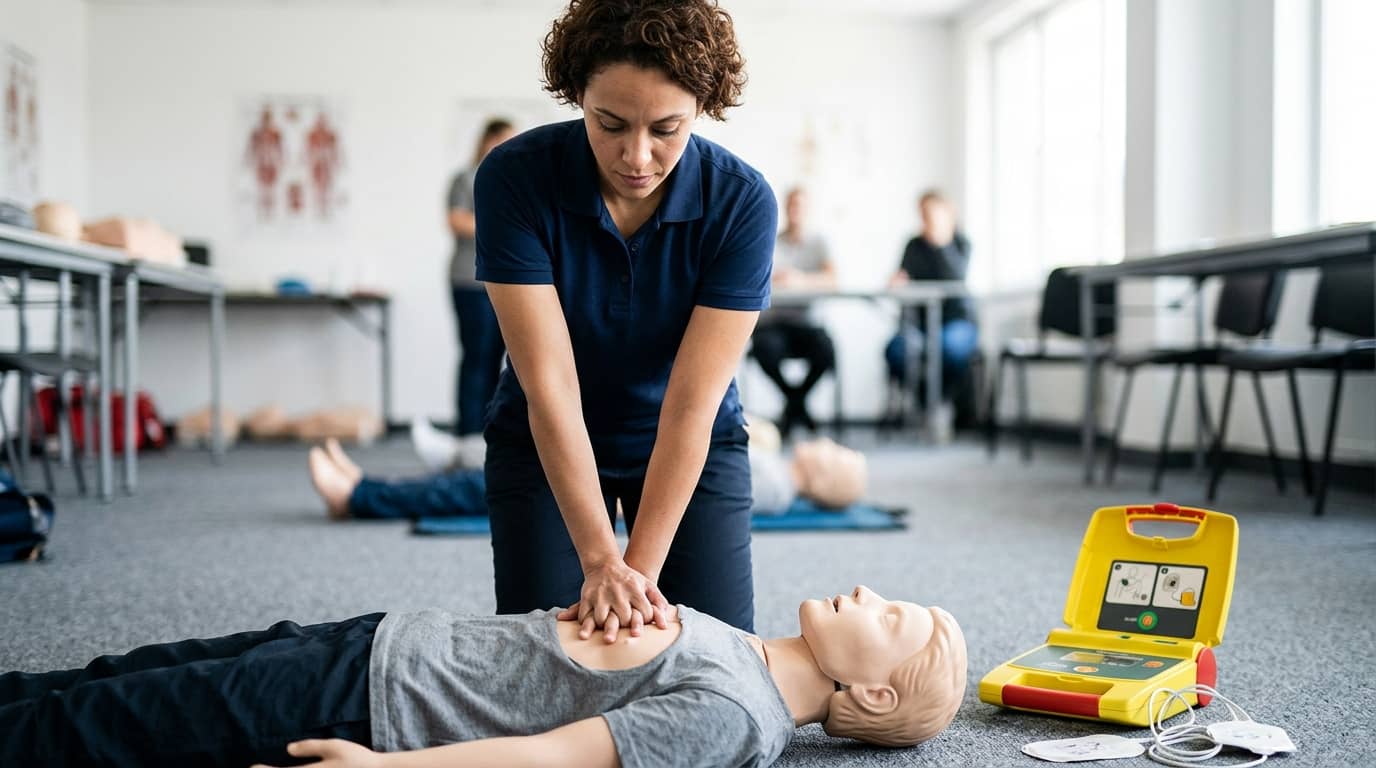
BLS/AED Course
When someone's heart stops, the next few minutes determine everything. This BLS/AED course gives you the hands-on skills to perform CPR, operate an AED, and manage choking emergencies across all age groups. Get certified and be the person who makes the difference when it counts most.
What you'll learn:
This course covers every core BLS skill you need to respond to cardiac and breathing emergencies with confidence. You will learn adult, child, and infant CPR techniques, including correct compression depth, rate, and ventilation ratios. You will master AED setup, pad placement, and safe shock delivery integrated into the CPR cycle. Airway management, choking relief, and scene safety are covered in full detail. You will also develop team communication skills for multi-rescuer resuscitation and learn how to hand off care to arriving ambulance service personnel.
How you study in practice BLS/AED Course
How you practise BLS/AED Course
For businesses looking to train their team
With Elevify for businesses, the course includes exercises and examples tailored to your own business and the way your company needs.

Course content
8 Chapters • 34 LessonsDuration between 4 and 360 hours (you decide)
Chapter 1HideHide detailsSee detailsFoundations of Emergency Response
Foundations of Emergency Response
Lesson 1 • Recognising Cardiac Arrest
Teaches the clinical signs of cardiac arrest versus other emergencies. Learners distinguish unresponsiveness and absent normal breathing accurately.
Lesson 2 • Scene Safety and Assessment
Covers systematic scene evaluation before approaching a victim. Learners apply safety checks to protect themselves and bystanders.
Lesson 3 • The Chain of Survival
Introduces the five-link chain of survival framework for cardiac emergencies. Learners connect each link to real-world response actions and outcomes.
Lesson 4 • Legal and Ethical Considerations
Explains Good Samaritan protections and consent principles for lay responders. Learners act confidently within ethical and legal boundaries.
Chapter 2HideHide detailsSee detailsAirway Management Essentials
Airway Management Essentials
Lesson 1 • Barrier Devices and Masks
Introduces pocket masks and face shields for safe rescue breathing. Learners achieve an effective seal and deliver adequate tidal volume.
Lesson 2 • Bag-Valve-Mask Operation
Teaches BVM assembly, sizing, and two-rescuer operation for ventilation. Learners deliver consistent tidal volumes without gastric inflation.
Lesson 3 • Manual Airway Opening Techniques
Covers head-tilt chin-lift and jaw-thrust manoeuvres for airway opening. Learners choose the correct technique based on suspected spinal injury.
Lesson 4 • Recognising and Clearing Obstructions
Identifies signs of airway obstruction and corrective actions during CPR. Learners respond to failed ventilation attempts with proper repositioning.
Chapter 3HideHide detailsSee detailsAdult CPR Fundamentals
Adult CPR Fundamentals
Lesson 1 • Positioning and Hand Placement
Covers correct victim positioning and rescuer hand placement for compressions. Proper setup directly determines compression effectiveness.
Lesson 2 • Rescuer Fatigue Management
Addresses compression quality decline due to fatigue and rotation strategies. Learners coordinate team switches to sustain high-quality CPR.
Lesson 3 • Rescue Breathing Technique
Demonstrates head-tilt chin-lift and proper breath delivery for adults. Learners integrate ventilations into the compression cycle correctly.
Lesson 4 • Compression Depth and Rate
Teaches the target compression depth and rate for adult CPR. Learners practise achieving consistent, guideline-compliant compressions.
Lesson 5 • Hands-Only CPR Application
Presents continuous chest compressions without ventilation as an alternative. Learners apply hands-only CPR when ventilation is not feasible.
Chapter 4HideHide detailsSee detailsAED Operation and Defibrillation
AED Operation and Defibrillation
Lesson 1 • AED Principles and Indications
Explains how AEDs analyse rhythm and deliver shocks for shockable rhythms. Learners identify when AED use is appropriate during cardiac arrest.
Lesson 2 • Special AED Considerations
Addresses AED use with implanted devices, wet surfaces, and medication patches. Learners adapt pad placement and preparation for these situations.
Lesson 3 • AED Setup and Pad Placement
Covers powering on the AED and correct pad placement for adults. Proper pad position ensures effective energy delivery to the heart.
Lesson 4 • Safe Shock Delivery
Teaches the clear-and-shock sequence to protect rescuers and bystanders. Learners verbalise safety checks and deliver shocks without delay.
Chapter 5HideHide detailsSee detailsCPR and AED for Children
CPR and AED for Children
Lesson 1 • Paediatric Anatomy and Physiology
Highlights key anatomical differences affecting CPR technique in children. Learners adjust their approach based on paediatric airway and chest structure.
Lesson 2 • Paediatric AED Use
Explains paediatric AED pads, dose attenuators, and placement adjustments. Learners select the correct AED mode and pad type for child victims.
Lesson 3 • Child Compression Technique
Teaches one-hand and two-hand compression methods for child victims. Learners achieve the correct depth of about two inches consistently.
Lesson 4 • Paediatric Rescue Breathing
Covers smaller tidal volumes and gentler breaths for child ventilation. Learners observe chest rise to confirm adequate but not excessive ventilation.
Chapter 6HideHide detailsSee detailsInfant BLS Techniques
Infant BLS Techniques
Lesson 1 • Infant Assessment and Activation
Covers responsiveness checks and emergency activation specific to infants. Learners recognise cardiac arrest signs unique to the infant population.
Lesson 2 • Two-Finger Compression Technique
Teaches single-rescuer two-finger compression placement and depth for infants. Learners achieve approximately one-and-a-half inches of compression depth.
Lesson 3 • Infant Rescue Breathing
Demonstrates mouth-to-mouth-and-nose technique and appropriate breath volume for infants. Learners deliver puffs sufficient only to produce visible chest rise.
Lesson 4 • Two-Thumb Encircling Technique
Presents the preferred two-rescuer two-thumb technique for infant compressions. Learners apply this method to generate superior coronary perfusion pressure.
Chapter 7HideHide detailsSee detailsChoking Management Across Ages
Choking Management Across Ages
Lesson 1 • Infant Back Blows and Chest Thrusts
Demonstrates five back blows and five chest thrusts for choking infants. Learners alternate cycles until the obstruction clears or the infant becomes unresponsive.
Lesson 2 • Unconscious Choking Victim Response
Addresses the transition to CPR when a choking victim loses consciousness. Learners check for visible objects before each ventilation attempt.
Lesson 3 • Adult and Child Abdominal Thrusts
Covers the Heimlich manoeuvre technique for conscious adults and children. Learners deliver firm, inward-upward thrusts until the object is expelled.
Lesson 4 • Recognising Airway Obstruction
Teaches the signs of mild versus severe airway obstruction in conscious victims. Learners distinguish when to intervene versus encourage coughing.
Chapter 8HideHide detailsSee detailsTeam Dynamics and Integrated Resuscitation
Team Dynamics and Integrated Resuscitation
Lesson 1 • Integrated Resuscitation Scenarios
Applies all BLS skills in simulated multi-rescuer scenarios with feedback. Learners identify performance gaps and self-correct in real time.
Lesson 2 • Closed-Loop Communication
Teaches message-confirmation communication to eliminate errors during CPR. Learners practise directing, acknowledging, and confirming all team actions.
Lesson 3 • Minimising Peri-Shock Pauses
Focuses on reducing CPR interruptions before and after AED shock delivery. Learners coordinate compression-to-shock and shock-to-compression transitions.
Lesson 4 • Roles in a Resuscitation Team
Defines compressor, ventilator, AED operator, and team leader roles. Clear role assignment prevents duplication and gaps during resuscitation.
Lesson 5 • Transition to Advanced Care
Covers handoff communication when advanced life support providers arrive. Learners deliver concise situation reports and continue CPR until relieved.

Your valid completion certificate
This course is for you:
Healthcare students: preparing for clinical rotations that require active BLS certification.
Workplace safety officers: responsible for maintaining emergency readiness across their organisation.
Coaches and athletic trainers: regularly supervising physical activity where cardiac events can occur.
Parents and caregivers: wanting reliable skills to protect children and family members at home.
Fitness professionals: working one-on-one with clients whose health history may carry cardiac risk.
Teachers and school staff: expected to respond to emergencies before ambulance service personnel arrive on campus.
What our students say
Hear from those who've already studied with us:
Your lessons are perfect. I purchased the one-year package and finally have the opportunity to follow various topics of interest without needing to change platforms... I'm grateful for everything you do, I've already recommended you to other people...

I like how the lessons are straight to the point and how I can change chapters and skip content I don't need.

I like the content and the way videos are presented and transcribed, which speeds up the process!

The platform is fast and simple to use. The diversity of content and complementary videos really help with learning.

Top upskilling courses




FAQ
Who is Elevify? How does it work?
Do the courses have certificates?
Are the courses free?
What is the course workload?
What are the courses like?
How do the courses work?
What is the duration of the courses?
What is the cost or price of the courses?
What is an EAD or online course and how does it work?
PDF Course