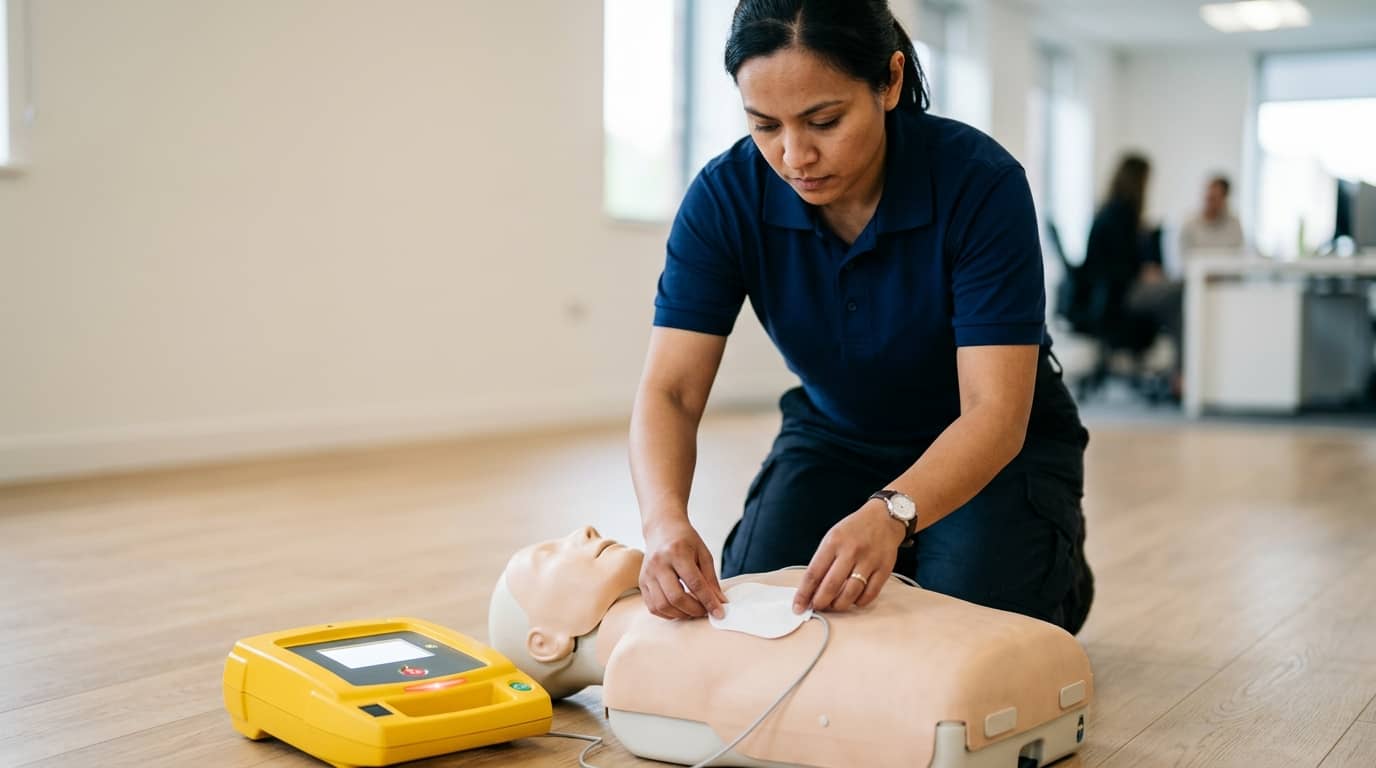
AED Course
When someone's heart stops, every second counts — and this AED course gives you the skills to act fast and act right. Learn to recognise sudden cardiac arrest, operate an AED with confidence, and deliver high-quality CPR until advanced help arrives. This training covers real-world scenarios, special patient populations, and team coordination so you're ready for any situation.
What you'll learn:
This course covers the complete AED response process from the ground up. You will learn how the heart works, what causes sudden cardiac arrest, and how defibrillation restores a normal rhythm. Step-by-step instruction walks you through powering on the device, preparing the patient, placing electrode pads correctly, and delivering a shock safely. You will also master adult, child, and infant CPR techniques and learn how to coordinate with a resuscitation team. Special situations such as wet environments, implanted devices, and crowded public spaces are addressed directly. By the end, you will know how to manage an AED programme, maintain equipment, and support responders after a cardiac event.
How you study in practice AED Course
How you practise AED Course
For businesses looking to train their team
With Elevify for businesses, the course includes exercises and examples tailored to your own business and the way your company needs.

Course content
8 Chapters • 35 LessonsDuration between 4 and 360 hours (you decide)
Chapter 1HideHide detailsSee detailsFoundations of Cardiac Emergencies
Foundations of Cardiac Emergencies
Lesson 1 • Anatomy of the Heart
Covers heart structure, electrical conduction, and how disruptions cause arrest. Provides the physiological basis for all AED interventions taught later.
Lesson 2 • Sudden Cardiac Arrest Overview
Defines sudden cardiac arrest, distinguishes it from a heart attack, and identifies common triggers. Grounds learners in accurate terminology used throughout the course.
Lesson 3 • The Chain of Survival
Introduces the sequential steps linking bystander action to advanced care. Learners see where AED use fits within the broader emergency response system.
Lesson 4 • Legal and Ethical Considerations
Explains Good Samaritan protections, duty to act, and consent principles for bystander responders. Removes legal hesitation that delays AED deployment.
Chapter 2HideHide detailsSee detailsUnderstanding AED Technology
Understanding AED Technology
Lesson 1 • AED Components and Controls
Identifies every physical part of a standard AED and its function. Familiarity with components reduces hesitation during actual device operation.
Lesson 2 • AED Placement and Access
Covers optimal placement strategies, signage requirements, and public access defibrillation programmes. Learners understand how to locate an AED quickly in any environment.
Lesson 3 • How Defibrillation Works
Explains the electrical shock mechanism that terminates fibrillation and restores organised rhythm. Connects device function to the cardiac physiology introduced in Chapter 1.
Lesson 4 • Types of AED Devices
Compares fully automated, semi-automated, and wearable AED models. Learners can select and operate the appropriate device for a given setting.
Chapter 3HideHide detailsSee detailsScene Safety and Patient Assessment
Scene Safety and Patient Assessment
Lesson 1 • Special Patient Considerations
Addresses assessment modifications for infants, children, pregnant individuals, and patients with implanted devices. Ensures correct protocol selection before AED application.
Lesson 2 • Breathing and Pulse Assessment
Teaches simultaneous breathing and pulse checks within a ten-second window. Rapid, accurate assessment determines whether CPR and AED use are indicated.
Lesson 3 • Checking Responsiveness
Covers verbal and tactile stimulation techniques to confirm unresponsiveness. Accurate responsiveness assessment prevents unnecessary AED deployment.
Lesson 4 • Scene Safety Principles
Teaches hazard identification, personal protective equipment use, and safe approach techniques. Safe scene entry is the prerequisite for every subsequent response action.
Chapter 4HideHide detailsSee detailsCPR Integration with AED Use
CPR Integration with AED Use
Lesson 1 • Pediatric and Infant CPR
Adapts compression depth, rate, and ventilation volume for children and infants. Builds on adult CPR skills with age-specific modifications.
Lesson 2 • Rescue Breathing Fundamentals
Teaches airway opening, mask seal, and ventilation volume for effective rescue breaths. Proper ventilation complements compressions to maintain oxygenation.
Lesson 3 • CPR and AED Coordination
Drills the handoff between CPR and AED analysis cycles to minimise no-flow time. Seamless coordination is the critical link between compressions and defibrillation.
Lesson 4 • Adult CPR Technique
Covers hand placement, compression depth, rate, and recoil for adult victims. Correct technique maximises perfusion pressure during cardiac arrest.
Chapter 5HideHide detailsSee detailsAED Operation Step by Step
AED Operation Step by Step
Lesson 1 • Patient Preparation for Pad Placement
Teaches chest exposure, skin drying, hair removal, and medication patch removal. Proper preparation ensures reliable pad adhesion and accurate rhythm analysis.
Lesson 2 • Electrode Pad Placement
Demonstrates correct anterior-lateral and anterior-posterior pad positions for adults and children. Accurate placement is essential for effective shock delivery.
Lesson 3 • Continuing Care After Shock
Covers post-shock CPR cycles, repeat analysis intervals, and signs of return of spontaneous circulation. Learners maintain effective care until advanced help arrives.
Lesson 4 • Rhythm Analysis and Shock Delivery
Guides learners through the analysis pause, shock advisory, and safe shock delivery. Correct execution at this stage directly determines defibrillation success.
Lesson 5 • Powering On and Preparing the Device
Covers opening the case, powering on, and confirming device readiness. Correct startup prevents delays caused by equipment errors.
Chapter 6HideHide detailsSee detailsSpecial Situations and Environments
Special Situations and Environments
Lesson 1 • Metal Surfaces and Electrical Hazards
Teaches safe AED use on metal floors, scaffolding, and near live electrical sources. Prevents rescuer injury while maintaining effective defibrillation.
Lesson 2 • Implanted Cardiac Devices
Explains how to identify and work around pacemakers and implantable cardioverter-defibrillators. Prevents pad placement errors that reduce shock effectiveness.
Lesson 3 • Water and Wet Environments
Addresses moving victims from water, drying the chest, and avoiding electrical hazards. Water is the most common environmental barrier to safe AED use.
Lesson 4 • Medication Patches and Skin Conditions
Covers removal of transdermal patches and management of skin conditions affecting pad adhesion. Ensures reliable electrical contact in non-standard patient presentations.
Lesson 5 • High-Stress and Crowded Environments
Develops crowd management, bystander direction, and communication skills during public cardiac events. Effective scene control improves both rescuer performance and victim outcomes.
Chapter 7HideHide detailsSee detailsTeam Dynamics and Resuscitation Leadership
Team Dynamics and Resuscitation Leadership
Lesson 1 • Roles in a Resuscitation Team
Defines compressor, ventilator, AED operator, and team leader roles. Clear role assignment prevents task overlap and gaps during resuscitation.
Lesson 2 • Transitioning to Advanced Care
Prepares learners to brief arriving paramedics and transfer patient care efficiently. Effective handoff preserves continuity and prevents information loss.
Lesson 3 • Role Rotation and Fatigue Management
Covers compressor rotation timing, smooth handoffs, and maintaining CPR quality over time. Fatigue degrades compression quality within two minutes without rotation.
Lesson 4 • Closed-Loop Communication
Teaches message-confirmation-acknowledgment communication to eliminate errors. Closed-loop technique is the standard for high-stakes medical team communication.
Chapter 8HideHide detailsSee detailsPost-Event Procedures and Program Management
Post-Event Procedures and Program Management
Lesson 1 • AED Maintenance and Readiness
Teaches daily inspection, pad and battery replacement schedules, and self-test verification. Routine maintenance ensures the AED is functional when needed.
Lesson 2 • Post-Resuscitation Patient Care
Covers recovery position, airway monitoring, and vital sign observation after return of circulation. Proper post-resuscitation care prevents secondary deterioration.
Lesson 3 • Incident Documentation and Reporting
Covers completing event reports, data download from AED memory, and regulatory submission. Accurate documentation supports quality improvement and legal compliance.
Lesson 4 • AED Programme Oversight and Compliance
Introduces programme coordinator responsibilities, regulatory compliance, and training record management. Organisational oversight ensures sustained AED programme effectiveness.
Lesson 5 • Responder Psychological Support
Addresses stress reactions, critical incident debriefing, and peer support resources for responders. Psychological care sustains responder readiness for future events.

Your valid completion certificate
This course is for you:
Workplace safety officer: responsible for keeping colleagues protected during emergencies.
Fitness trainer: regularly works with clients who face elevated cardiac risk.
School staff member: needs confidence to respond if a student collapses suddenly.
Security professional: first on scene before paramedics arrive in many facilities.
Concerned parent: wants to be prepared if a family member experiences cardiac arrest.
HR manager: building or expanding a company-wide emergency response programme.
What our students say
Hear from those who've already studied with us:
Your lessons are perfect. I purchased the one-year package and finally have the opportunity to follow various topics of interest without needing to change platforms... I'm grateful for everything you do, I've already recommended you to other people...

I like how the lessons are straight to the point and how I can change chapters and skip content I don't need.

I like the content and the way videos are presented and transcribed, which speeds up the process!

The platform is fast and simple to use. The diversity of content and complementary videos really help with learning.

Top upskilling courses




FAQ
Who is Elevify? How does it work?
Do the courses have certificates?
Are the courses free?
What is the course workload?
What are the courses like?
How do the courses work?
What is the duration of the courses?
What is the cost or price of the courses?
What is an EAD or online course and how does it work?
PDF Course