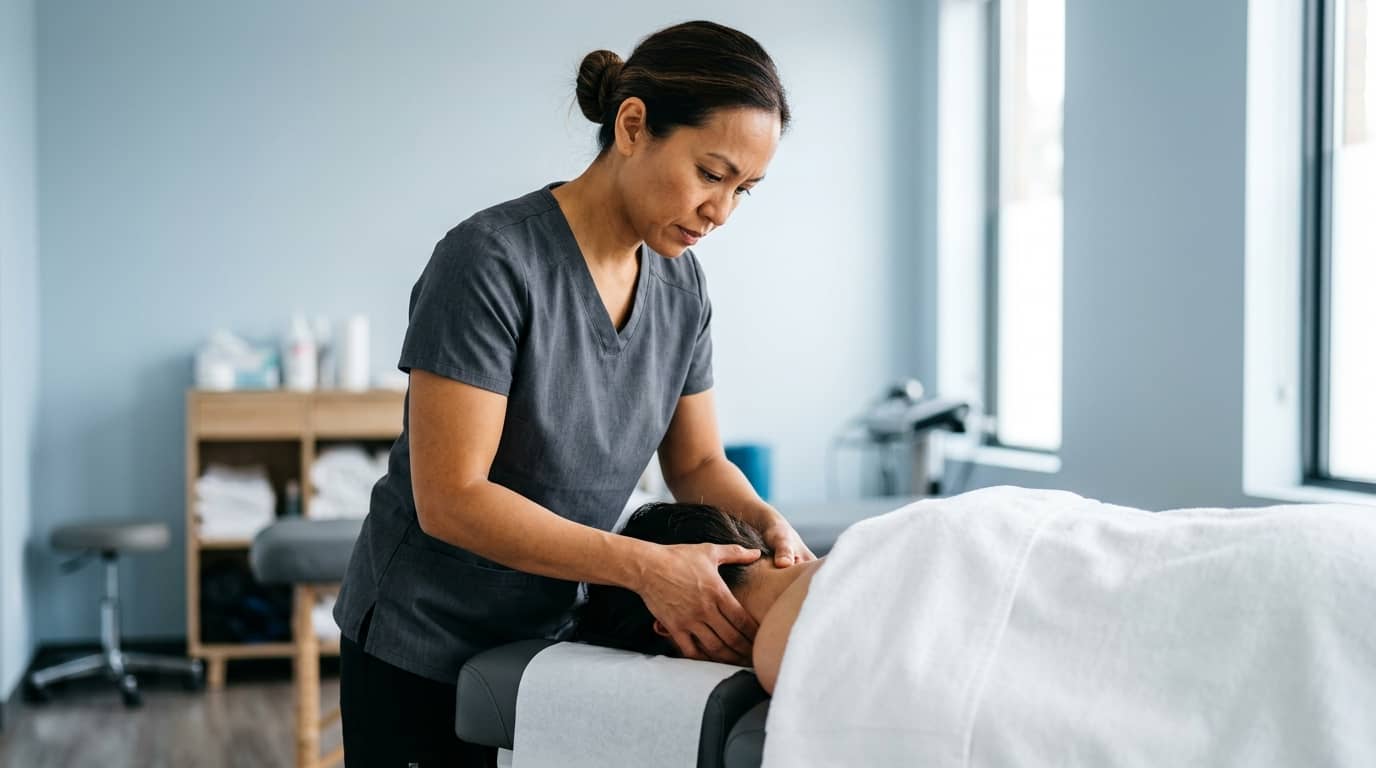
Chiropractic Massage Course
Master the hands-on skills that chiropractic practices demand most. This course takes you from foundational anatomy and neurophysiology through advanced myofascial techniques, condition-specific protocols, and professional documentation. Whether you are entering the field or expanding your clinical toolkit, you will finish ready to deliver results.
What you'll learn:
You will build a complete skill set covering musculoskeletal anatomy, biomechanics, and the neurological basis of manual therapy. You will learn how to assess clients through health history intake, postural analysis, and range of motion testing. Core massage strokes, spinal region techniques, and extremity protocols are covered in step-by-step detail. You will also master myofascial release, trigger point therapy, and condition-specific treatment plans for the most common clinical presentations. Professional skills including SOAP documentation, treatment planning, interdisciplinary referral, and ethical standards are integrated throughout.
How you study in practice Chiropractic Massage Course
How you practise Chiropractic Massage Course
For businesses looking to train their team
With Elevify for businesses, the course includes exercises and examples tailored to your own business and the way your company needs.

Course content
8 Chapters • 40 LessonsDuration between 4 and 360 hours (you decide)
Chapter 1HideHide detailsSee detailsFoundations of Chiropractic Massage
Foundations of Chiropractic Massage
Lesson 1 • Professional and Regulatory Standards
Outlines licensing requirements, documentation duties, and ethical obligations for practitioners. Prepares students for compliant professional practice.
Lesson 2 • Musculoskeletal Anatomy Review
Covers bones, joints, muscles, and connective tissue relevant to manual therapy. Builds the anatomical vocabulary used throughout the course.
Lesson 3 • History and Scope of Practice
Traces chiropractic massage from its origins to modern integration with manual therapy. Provides context for professional identity and scope boundaries.
Lesson 4 • Neurological Basis of Manual Therapy
Explains how the nervous system mediates pain, muscle tone, and therapeutic response. Links neurophysiology to expected clinical outcomes.
Lesson 5 • Biomechanics and Postural Assessment
Introduces force, load, and alignment principles governing spinal and joint health. Students apply postural observation to identify dysfunction patterns.
Chapter 2HideHide detailsSee detailsClient Assessment and Intake
Client Assessment and Intake
Lesson 1 • Range of Motion Testing
Covers active, passive, and resisted motion tests for the spine and extremities. Results quantify dysfunction and establish a measurable treatment baseline.
Lesson 2 • Postural and Gait Analysis
Teaches systematic visual assessment of standing posture and walking patterns. Findings are correlated with likely soft-tissue and joint dysfunctions.
Lesson 3 • Health History and Intake Forms
Guides students through designing and administering comprehensive health history forms. Accurate intake data directly informs treatment decisions.
Lesson 4 • Contraindications and Precautions
Defines absolute and relative contraindications for chiropractic massage. Students practise clinical decision-making to modify or defer treatment safely.
Lesson 5 • Palpation Skills and Tissue Assessment
Develops tactile sensitivity to detect muscle tension, trigger points, and tissue quality. Palpation findings guide technique selection in subsequent chapters.
Chapter 3HideHide detailsSee detailsCore Massage Techniques and Strokes
Core Massage Techniques and Strokes
Lesson 1 • Practitioner Body Mechanics
Establishes ergonomic principles that protect the practitioner during prolonged sessions. Correct stance, leverage, and table height reduce injury risk.
Lesson 2 • Tapotement and Vibration
Introduces percussive and oscillatory strokes that stimulate neuromuscular response. Appropriate clinical contexts and contraindications are identified.
Lesson 3 • Effleurage and Superficial Gliding
Introduces long, gliding strokes used to warm tissue and establish client contact. Proper hand contouring and pressure gradients are emphasised.
Lesson 4 • Petrissage and Kneading Methods
Covers lifting, squeezing, and rolling techniques that mobilise deeper muscle layers. Students learn to adapt grip and rhythm to different tissue densities.
Lesson 5 • Friction and Cross-Fibre Techniques
Teaches focused transverse and circular friction to address adhesions and scar tissue. Correct depth and angle prevent tissue damage while maximising effect.
Chapter 4HideHide detailsSee detailsSpinal Region Techniques
Spinal Region Techniques
Lesson 1 • Prone and Supine Positioning Protocols
Teaches safe draping, bolstering, and repositioning for spinal region work. Proper positioning protects vulnerable structures and maximises access.
Lesson 2 • Thoracic Spine and Rib Cage Work
Addresses paraspinal muscles, rhomboids, and intercostal tissues of the mid-back. Techniques improve thoracic mobility and support respiratory function.
Lesson 3 • Spinal Mobilisation Support Techniques
Prepares soft tissue before and after chiropractic adjustments to enhance outcomes. Students learn sequencing massage with spinal manipulation safely.
Lesson 4 • Cervical Spine Massage Protocols
Covers soft-tissue work for the neck, suboccipital region, and upper trapezius. Techniques address common cervicogenic pain and tension headache patterns.
Lesson 5 • Lumbar Spine and Sacral Techniques
Focuses on erector spinae, quadratus lumborum, and sacroiliac soft-tissue work. Protocols address low-back pain, the most common clinical presentation.
Chapter 5HideHide detailsSee detailsExtremity and Joint Massage Techniques
Extremity and Joint Massage Techniques
Lesson 1 • Shoulder Girdle and Upper Arm
Covers rotator cuff muscles, deltoid, and pectoral soft-tissue techniques. Addresses impingement, frozen shoulder, and postural shoulder dysfunction.
Lesson 2 • Joint Mobilisation and Stretching Integration
Combines soft-tissue work with passive joint mobilisation and assisted stretching. Students sequence techniques to maximise joint range of motion gains.
Lesson 3 • Hip and Gluteal Region Protocols
Addresses piriformis, hip flexors, and gluteal muscles contributing to low-back and leg pain. Techniques are adapted for side-lying and prone positions.
Lesson 4 • Knee, Lower Leg, and Foot Work
Covers quadriceps, hamstrings, gastrocnemius, and plantar fascia techniques. Protocols address knee pain, shin splints, and plantar fasciitis.
Lesson 5 • Forearm, Wrist, and Hand Techniques
Targets flexor and extensor compartments, carpal tunnel region, and intrinsic hand muscles. Addresses repetitive strain injuries common in manual workers.
Chapter 6HideHide detailsSee detailsMyofascial and Trigger Point Therapy
Myofascial and Trigger Point Therapy
Lesson 1 • Trigger Point Identification and Treatment
Covers active versus latent trigger points, referral patterns, and ischaemic compression. Students map common trigger points across major muscle groups.
Lesson 2 • Dry Needling Awareness and Collaboration
Provides an overview of dry needling as a complementary trigger point intervention. Students learn when to refer and how to coordinate care with needling practitioners.
Lesson 3 • Integrating Myofascial Work into Sessions
Guides sequencing of myofascial and trigger point work within a full treatment session. Students balance time, client tolerance, and therapeutic goals.
Lesson 4 • Fascial Anatomy and Dysfunction
Explains fascial continuity, tensegrity, and how restrictions develop and propagate. Provides the theoretical basis for myofascial release interventions.
Lesson 5 • Myofascial Release Techniques
Teaches sustained pressure and skin-drag methods to release fascial barriers. Students distinguish direct and indirect release approaches.
Chapter 7HideHide detailsSee detailsCondition-Specific Treatment Protocols
Condition-Specific Treatment Protocols
Lesson 1 • Acute and Chronic Low-Back Pain
Differentiates acute and chronic low-back presentations and adapts technique intensity accordingly. Protocols integrate lumbar, sacral, and hip soft-tissue work.
Lesson 2 • Cervicogenic Headache and Neck Pain
Presents a structured protocol for suboccipital, cervical, and upper thoracic soft-tissue work. Addresses the most frequent complaint in chiropractic practice.
Lesson 3 • Hip and Sciatic Pain Protocols
Addresses piriformis syndrome, hip flexor tightness, and referred sciatic pain patterns. Protocols differentiate true sciatica from piriformis-mediated referral.
Lesson 4 • Shoulder Impingement and Rotator Cuff
Targets soft-tissue contributors to shoulder impingement and rotator cuff dysfunction. Students sequence pectoral, rotator cuff, and scapular stabiliser work.
Lesson 5 • Repetitive Strain and Overuse Injuries
Covers carpal tunnel syndrome, lateral epicondylitis, and plantar fasciitis treatment. Students apply friction, myofascial, and stretching techniques systematically.
Chapter 8HideHide detailsSee detailsSession Design and Clinical Practice
Session Design and Clinical Practice
Lesson 1 • Interdisciplinary Collaboration and Referral
Defines the practitioner's role within a multidisciplinary healthcare team. Students practise referral communication and co-management documentation.
Lesson 2 • SOAP Notes and Clinical Documentation
Teaches the SOAP format for recording subjective, objective, assessment, and plan data. Accurate notes support continuity of care and professional accountability.
Lesson 3 • Outcome Measurement and Progress Tracking
Introduces validated outcome tools to quantify pain, function, and client satisfaction. Data-driven tracking justifies ongoing treatment and guides protocol adjustments.
Lesson 4 • Full-Session Sequencing and Flow
Structures a complete session from intake review through closing techniques. Students practise smooth transitions and time management across body regions.
Lesson 5 • Treatment Planning and Goal Setting
Translates assessment findings into measurable short- and long-term treatment goals. Goals guide technique selection and define session success criteria.

Your valid completion certificate
This course is for you:
Licensed massage therapist: seeking to transition into clinical chiropractic environments.
Chiropractic assistant: wanting hands-on soft-tissue skills to support patient care.
Personal trainer: looking to add manual therapy knowledge to a wellness practice.
Physical therapy aide: aiming to deepen understanding of musculoskeletal treatment methods.
Career changer: entering the healthcare field through a practical, skill-focused pathway.
Holistic health practitioner: expanding services to include evidence-informed manual therapy techniques.
What our students say
Hear from those who've already studied with us:
Your lessons are perfect. I purchased the one-year package and finally have the opportunity to follow various topics of interest without needing to change platforms... I'm grateful for everything you do, I've already recommended you to other people...

I like how the lessons are straight to the point and how I can change chapters and skip content I don't need.

I like the content and the way videos are presented and transcribed, which speeds up the process!

The platform is fast and simple to use. The diversity of content and complementary videos really help with learning.

Top upskilling courses


FAQ
Who is Elevify? How does it work?
Do the courses have certificates?
Are the courses free?
What is the course workload?
What are the courses like?
How do the courses work?
What is the duration of the courses?
What is the cost or price of the courses?
What is an EAD or online course and how does it work?
PDF Course