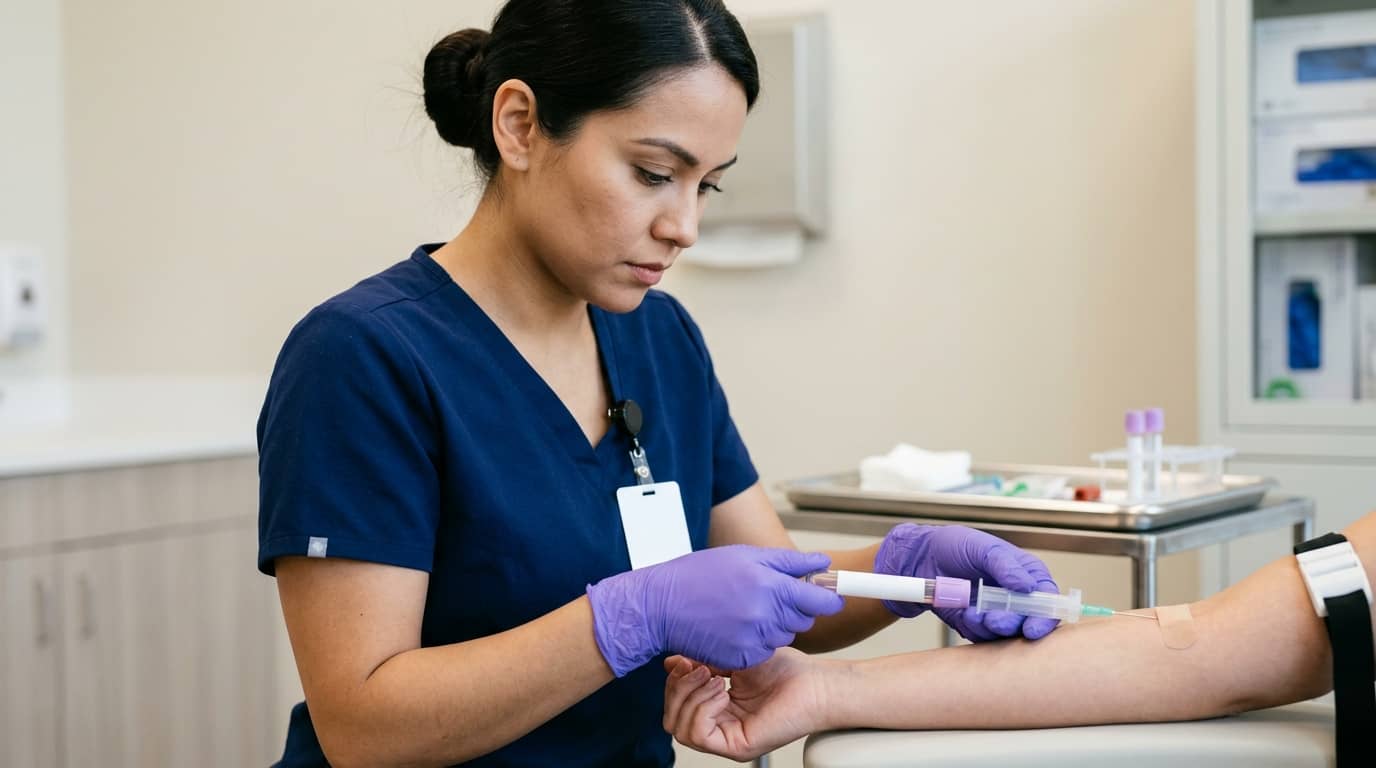
Blood Draw Course
This Blood Draw Course gives you the hands-on knowledge and procedural skills to perform safe, accurate blood collection in real clinical settings. From vein anatomy and infection control to tube selection and specimen transport, every critical step is covered. Get certified-ready and job-ready with training built for aspiring and practising phlebotomists.
What you'll learn:
You will learn how to identify venipuncture sites, select the correct equipment, and perform blood draws on adult, paediatric, and geriatric patients. The course covers infection control protocols, PPE use, and sharps safety so you can protect yourself and your patients every time. You will master the order of draw, tube colour-coding, and specimen labelling requirements that laboratories demand. Capillary and arterial collection methods, including fingerstick and arterial blood gas procedures, are also included. You will finish with a clear understanding of quality indicators, complication management, and the certification pathways that advance your phlebotomy career.
How you study in practice Blood Draw Course
How you practise Blood Draw Course
For businesses looking to train their team
With Elevify for businesses, the course includes exercises and examples tailored to your own business and the way your company needs.

Course content
8 Chapters • 34 LessonsDuration between 4 and 360 hours (you decide)
Chapter 1HideHide detailsSee detailsFoundations of Phlebotomy Practice
Foundations of Phlebotomy Practice
Lesson 1 • Vascular and Anatomical Landmarks
Identifies veins, arteries, and capillaries relevant to venipuncture and capillary collection. Accurate landmark recognition reduces missed sticks and patient discomfort.
Lesson 2 • Regulatory and Accreditation Overview
Surveys occupational safety regulations, laboratory accreditation standards, and quality frameworks governing blood collection. Compliance knowledge is applied in every procedural chapter.
Lesson 3 • Professional and Ethical Standards
Defines scope of practice, patient rights, and confidentiality obligations for phlebotomists. Ethical conduct underpins every patient interaction covered in later chapters.
Lesson 4 • Blood Composition and Function
Covers cellular and plasma components, their roles in hemostasis and transport. Provides the physiological basis needed to understand specimen requirements throughout the course.
Chapter 2HideHide detailsSee detailsInfection Control and Safety Protocols
Infection Control and Safety Protocols
Lesson 1 • Sharps Safety and Needlestick Prevention
Teaches safe needle activation, one-hand recapping prohibition, and sharps container protocols. Sharps injuries are the leading occupational hazard addressed throughout the course.
Lesson 2 • Personal Protective Equipment Selection
Covers glove types, gown use, eye protection, and mask selection based on exposure risk. Correct PPE choice is reinforced in every hands-on lab session.
Lesson 3 • Standard Precautions in Phlebotomy
Defines standard precautions and transmission-based precaution tiers for bloodborne pathogen control. These principles frame all safety decisions made during specimen collection.
Lesson 4 • Workspace Decontamination Procedures
Details surface disinfection, biohazard waste segregation, and spill management for the collection area. A clean workspace prevents cross-contamination of specimens and personnel.
Chapter 3HideHide detailsSee detailsEquipment, Supplies, and Tube Selection
Equipment, Supplies, and Tube Selection
Lesson 1 • Ancillary Supplies and Tourniquets
Covers tourniquet types, antiseptic wipes, gauze, bandages, and labelling materials needed at the draw site. Proper supply preparation reduces procedure interruptions.
Lesson 2 • Order of Draw Principles
Establishes the standardised sequence for filling multiple tubes to prevent additive carryover contamination. Correct order of draw is mandatory for valid multi-tube collections.
Lesson 3 • Needle Gauges and Holder Systems
Explains gauge numbering, bevel orientation, and compatibility with evacuated tube systems and syringes. Needle selection affects blood flow rate and haemolysis risk.
Lesson 4 • Evacuated Tube Colour-Coding System
Maps tube stopper colours to additives, anticoagulants, and intended laboratory departments. Tube selection errors cause specimen rejection and patient re-draws.
Chapter 4HideHide detailsSee detailsPatient Identification and Preparation
Patient Identification and Preparation
Lesson 1 • Fasting and Dietary Preparation
Explains fasting requirements for lipid panels, glucose tests, and other analyte-sensitive assays. Confirming preparation status prevents invalid results and repeat collections.
Lesson 2 • Two-Identifier Verification Protocol
Teaches active confirmation of name and date of birth or medical record number before every draw. Misidentification is a sentinel event prevented at this step.
Lesson 3 • Pre-Draw Patient Assessment
Assesses patient anxiety, fainting history, medication use, and arm condition before selecting a site. Assessment findings guide site selection and complication prevention strategies.
Lesson 4 • Test Requisition and Order Review
Covers reading electronic and paper requisitions, verifying test codes, and clarifying ambiguous orders before collection. Requisition accuracy prevents wrong-tube and wrong-test errors.
Chapter 5HideHide detailsSee detailsVenipuncture Technique: Step-by-Step
Venipuncture Technique: Step-by-Step
Lesson 1 • Site Selection and Vein Palpation
Teaches systematic palpation to assess vein depth, direction, and resilience before needle insertion. Accurate site selection is the single greatest predictor of first-stick success.
Lesson 2 • Difficult Vein Strategies
Addresses techniques for small, rolling, deep, and fragile veins including warming, hydration prompts, and alternate sites. These strategies reduce repeat sticks and patient discomfort.
Lesson 3 • Tube Mixing and Needle Removal
Explains inversion counts per tube type, tourniquet release timing, and safe needle withdrawal with pressure application. Proper mixing and removal prevent clotting errors and haematoma formation.
Lesson 4 • Needle Insertion and Tube Engagement
Demonstrates 15–30 degree insertion angle, bevel-up entry, and smooth tube engagement without needle movement. Correct insertion mechanics prevent haematoma and failed draws.
Lesson 5 • Skin Antisepsis and Site Preparation
Covers antiseptic application, drying time, and no-touch technique to prevent site contamination. Proper antisepsis reduces post-draw infection risk and blood culture contamination rates.
Chapter 6HideHide detailsSee detailsCapillary and Arterial Blood Collection
Capillary and Arterial Blood Collection
Lesson 1 • Capillary Puncture Principles
Explains the composition difference between capillary and venous blood and its effect on reference ranges. Understanding these differences prevents misinterpretation of capillary results.
Lesson 2 • Arterial Blood Gas Collection
Covers radial artery site selection, modified Allen test, heparinised syringe use, and post-draw pressure requirements. ABG collection carries higher risk and requires demonstrated competency.
Lesson 3 • Neonatal Heelstick Procedure
Teaches heel warming, medial and lateral plantar surface puncture zones, and newborn screening card collection. Heelstick errors in neonates carry significant clinical consequences.
Lesson 4 • Fingerstick Technique for Adults
Covers lancet selection, puncture site on the lateral fingertip, and correct blood drop collection sequence. Proper technique prevents haemolysis from excessive squeezing.
Chapter 7HideHide detailsSee detailsSpecimen Handling, Labelling, and Transport
Specimen Handling, Labelling, and Transport
Lesson 1 • Specimen Processing and Centrifugation
Covers clot time requirements, centrifuge speed and duration settings, and aliquoting procedures for serum and plasma. Incorrect processing alters analyte concentrations and invalidates results.
Lesson 2 • Specimen Transport and Chain of Custody
Explains pneumatic tube system use, courier packaging, and chain-of-custody documentation for legal specimens. Transport failures account for a significant proportion of pre-analytical errors.
Lesson 3 • Temperature and Storage Requirements
Maps analyte-specific temperature requirements from room temperature to frozen storage and explains stability windows. Improper storage degrades analytes and forces repeat collections.
Lesson 4 • Specimen Labelling Requirements
Defines mandatory label fields, timing of labelling at bedside, and consequences of mislabelled specimens. Labels must be applied before leaving the patient's side without exception.
Chapter 8HideHide detailsSee detailsComplications, Quality, and Competency
Complications, Quality, and Competency
Lesson 1 • Competency Assessment and Certification
Outlines direct observation checklists, written examination components, and national certification pathways for phlebotomists. Certification validates competency to employers and regulatory bodies.
Lesson 2 • Quality Indicators and Performance Metrics
Introduces first-stick success rate, recollection rate, and turnaround time as key phlebotomy quality metrics. Tracking metrics enables targeted improvement and professional accountability.
Lesson 3 • Continuous Improvement and Reflective Practice
Applies root cause analysis, peer feedback, and self-assessment to reduce error rates over time. Reflective practice transforms individual errors into systemic quality improvements.
Lesson 4 • Pre-Analytical Error Identification
Catalogues haemolysis, clotting, short draws, and wrong-tube errors with their causes and prevention strategies. Pre-analytical errors represent the majority of laboratory quality failures.
Lesson 5 • Recognising and Managing Complications
Identifies haematoma, syncope, nerve injury, arterial puncture, and allergic reactions with immediate response steps. Early recognition and correct response prevent escalation of adverse events.

Your valid completion certificate
This course is for you:
Aspiring phlebotomists: building foundational skills before entering the workforce.
Medical assistants: expanding scope to include blood collection responsibilities.
Nursing students: strengthening clinical confidence with dedicated venipuncture training.
Career changers: transitioning into healthcare from unrelated professional backgrounds.
EMTs and paramedics: formalising blood draw skills for broader clinical roles.
Clinic volunteers: preparing to support licensed staff during specimen collection procedures.
What our students say
Hear from those who've already studied with us:
Your lessons are perfect. I purchased the one-year package and finally have the opportunity to follow various topics of interest without needing to change platforms... I'm grateful for everything you do, I've already recommended you to other people...

I like how the lessons are straight to the point and how I can change chapters and skip content I don't need.

I like the content and the way videos are presented and transcribed, which speeds up the process!

The platform is fast and simple to use. The diversity of content and complementary videos really help with learning.

Top upskilling courses





FAQ
Who is Elevify? How does it work?
Do the courses have certificates?
Are the courses free?
What is the course workload?
What are the courses like?
How do the courses work?
What is the duration of the courses?
What is the cost or price of the courses?
What is an EAD or online course and how does it work?
PDF Course