Chinese Auriculotherapy Course
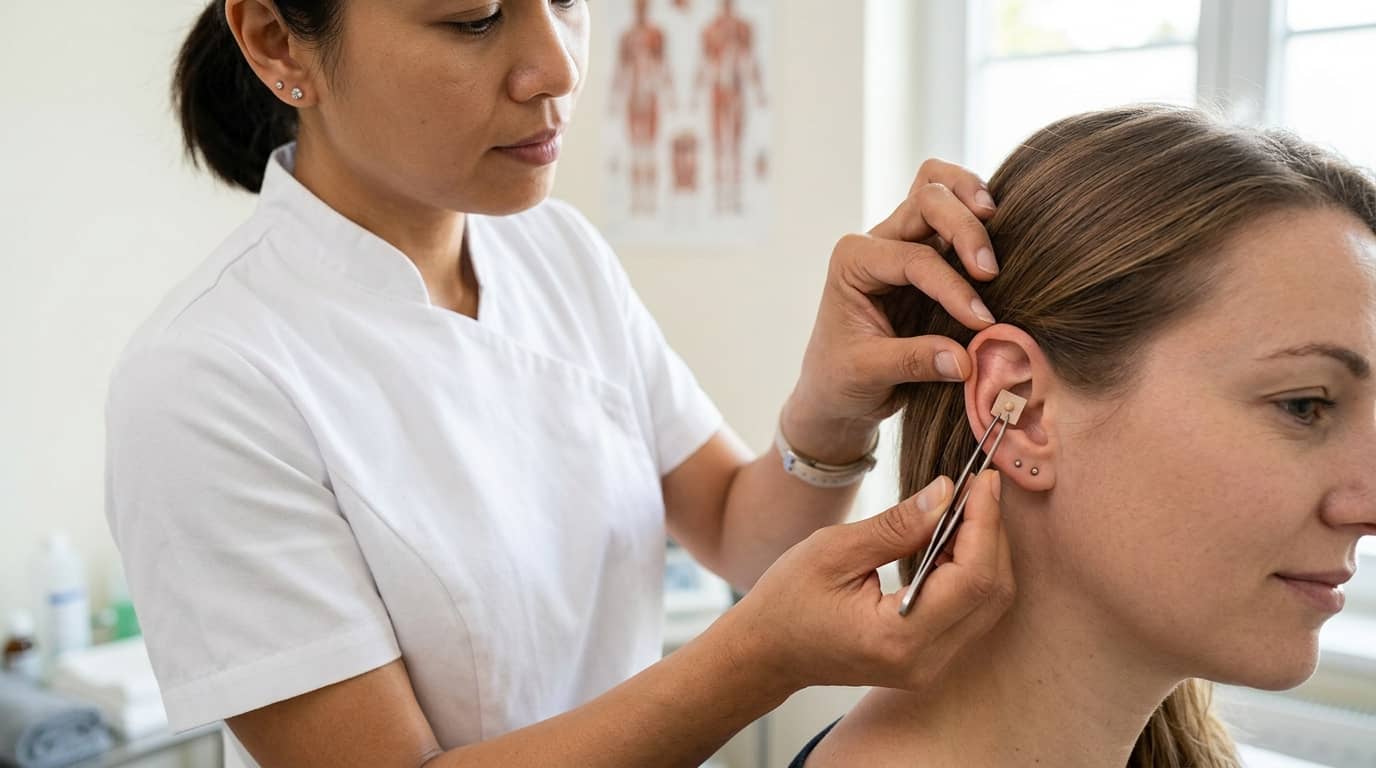
Master the complete system of Chinese auriculotherapy, from ear anatomy and TCM diagnosis to hands-on stimulation techniques and clinical protocol design. This course gives you the theoretical foundation and practical skills to treat real patients with confidence. Whether you are entering the field or expanding your practice, this is the training that gets you there.
What you'll learn:
You will learn the core principles of traditional Chinese medicine as they apply to auriculotherapy, including qi, yin-yang, and the five elements theory. You will gain knowledge of external ear anatomy and locate over 100 standard auricular points. The course covers TCM diagnostic methods, pattern differentiation, and translating a patient's condition into a treatment strategy. You will practise all stimulation modalities — acupressure, ear seeds, needling, laser, and electrical stimulation. Safety protocols, infection control, and adverse-event management are included. You will design clinical protocols for pain, digestive issues, stress, insomnia, and addiction. Advanced modules address special populations, integrative care, and building a professional practice.
How you study in practice Chinese Auriculotherapy Course
How you practise Chinese Auriculotherapy Course
For businesses looking to train their team
With Elevify for businesses, the course includes exercises and examples tailored to your own business and the way your company needs.

Course content
8 Chapters • 36 LessonsDuration between 4 and 360 hours (you decide)
Chapter 1HideHide detailsSee detailsFoundations of Auriculotherapy
Foundations of Auriculotherapy
Lesson 1 • Scope, Ethics, and Professional Standards
Defines the professional boundaries and ethical responsibilities of auriculotherapy practice. Prepares students to operate within appropriate regulatory and safety frameworks.
Lesson 2 • The Ear as a Microsystem
Explains the microsystem theory linking the ear to the whole body. Students understand why specific ear zones correspond to organs and body regions.
Lesson 3 • History and Origins of Ear Medicine
Traces auriculotherapy from ancient Chinese texts to modern clinical practice. Contextualises the discipline within the broader evolution of traditional Chinese medicine.
Lesson 4 • Core Principles of Traditional Chinese Medicine
Introduces qi, yin-yang, and the five-element theory as they apply to auriculotherapy. Provides the conceptual language used throughout the entire course.
Chapter 2HideHide detailsSee detailsAnatomy of the External Ear
Anatomy of the External Ear
Lesson 1 • Zones and Regions of the Ear
Divides the auricle into functional zones used in Chinese auriculotherapy mapping. Zone recognition is the bridge between anatomy and therapeutic point selection.
Lesson 2 • Surface Anatomy of the Auricle
Identifies the ridges, fossae, and landmarks of the external ear in clinical detail. Accurate naming of structures is essential for all subsequent point-location work.
Lesson 3 • Neurological and Vascular Supply
Covers the nerve branches and blood vessels serving the auricle. Understanding innervation explains the physiological basis of auricular stimulation effects.
Lesson 4 • Anatomical Variation and Clinical Adaptation
Addresses natural variation in ear shape and size across individuals. Students learn to adapt standard maps to atypical ear morphology.
Chapter 3HideHide detailsSee detailsAuricular Point Mapping and Location
Auricular Point Mapping and Location
Lesson 1 • Organ Representation Points
Maps points corresponding to internal organs across the concha and surrounding zones. These points form the core of most auriculotherapy treatment protocols.
Lesson 2 • Musculoskeletal and Neurological Points
Locates points for the spine, joints, and nervous system on the antihelix and surrounding areas. These points are critical for pain management and neurological applications.
Lesson 3 • Functional and Special Points
Identifies high-utility points such as Shen Men, Point Zero, and sympathetic points. These points appear in nearly every clinical protocol and require precise location.
Lesson 4 • Point Detection Techniques
Teaches electrical, pressure, and visual methods for confirming active auricular points. Accurate detection distinguishes reactive points from adjacent inactive tissue.
Lesson 5 • Chinese Standard Point Nomenclature
Introduces the official Chinese naming and numbering system for auricular points. Consistent terminology prevents clinical errors and supports professional communication.
Chapter 4HideHide detailsSee detailsTCM Diagnosis for Auricular Treatment
TCM Diagnosis for Auricular Treatment
Lesson 1 • Auricular Diagnosis Methods
Uses the ear itself as a diagnostic tool through colour, texture, and reactive point analysis. Auricular findings are correlated with TCM patterns to confirm treatment focus.
Lesson 2 • Pattern Differentiation in TCM
Teaches identification of excess, deficiency, cold, heat, and other core TCM patterns. Pattern differentiation determines which auricular points and stimulation methods are appropriate.
Lesson 3 • Four Pillars of TCM Diagnosis
Covers inspection, auscultation, inquiry, and palpation as the diagnostic framework. Each pillar yields specific data that informs auricular point selection.
Lesson 4 • Treatment Principle Formulation
Translates TCM diagnosis into a clear treatment principle guiding point selection. Students practise moving from diagnosis to a logical, individualised auricular protocol.
Chapter 5HideHide detailsSee detailsStimulation Methods and Tools
Stimulation Methods and Tools
Lesson 1 • Auricular Acupuncture Needling
Introduces sterile needle insertion into auricular points using correct angle, depth, and retention time. Needling requires prior anatomy mastery and strict aseptic protocol.
Lesson 2 • Laser and Light Therapy on the Ear
Uses low-level laser therapy to stimulate auricular points without skin penetration. Laser modality is preferred for needle-phobic patients and paediatric populations.
Lesson 3 • Moxibustion and Warmth Techniques
Applies indirect heat stimulation to auricular points using moxa and warming devices. Warmth techniques are used for cold-pattern and deficiency conditions in TCM diagnosis.
Lesson 4 • Acupressure and Seed Therapy
Covers non-invasive stimulation using seeds, pellets, and manual pressure on auricular points. This is the safest entry-level modality and the most common patient self-care tool.
Lesson 5 • Electrical Stimulation of Auricular Points
Applies transcutaneous electrical stimulation to auricular points using dedicated devices. Electrical parameters are adjusted to achieve analgesic or regulatory effects.
Chapter 6HideHide detailsSee detailsSafety, Hygiene, and Clinical Management
Safety, Hygiene, and Clinical Management
Lesson 1 • Clinical Documentation and Record Keeping
Establishes standards for patient records, treatment notes, and outcome tracking. Accurate documentation supports continuity of care and professional accountability.
Lesson 2 • Managing Adverse Reactions
Prepares students to recognise and respond to fainting, infection, and allergic reactions. Prompt, competent management of adverse events is a core clinical safety skill.
Lesson 3 • Contraindications and Risk Assessment
Identifies absolute and relative contraindications for each stimulation modality. Risk assessment before each session prevents adverse outcomes and legal liability.
Lesson 4 • Infection Control and Sterilisation
Applies standard infection control procedures to all auriculotherapy tools and surfaces. Proper sterilisation prevents cross-contamination and protects both patient and practitioner.
Chapter 7HideHide detailsSee detailsClinical Protocol Design
Clinical Protocol Design
Lesson 1 • Digestive and Metabolic Protocols
Addresses gastrointestinal and metabolic conditions through organ-specific auricular points. Protocol design integrates TCM organ patterns with functional digestive presentations.
Lesson 2 • Stress, Anxiety, and Sleep Protocols
Constructs protocols targeting the autonomic nervous system for stress and insomnia. These conditions respond strongly to auricular stimulation of Shen Men and related points.
Lesson 3 • Protocol Structure and Session Planning
Establishes the components of a complete auriculotherapy session from intake to discharge. Structured planning ensures consistency, safety, and measurable outcomes.
Lesson 4 • Addiction and Behavioural Protocols
Applies the NADA protocol and related approaches to substance use and behavioural conditions. Students understand the evidence base and adapt the protocol to individual needs.
Lesson 5 • Pain Management Protocols
Develops auricular protocols for acute and chronic pain conditions using analgesic points. Pain is the most common clinical application and the benchmark for protocol competency.
Chapter 8HideHide detailsSee detailsAdvanced Clinical Practice and Integration
Advanced Clinical Practice and Integration
Lesson 1 • Clinical Supervision and Case Presentation
Develops skills in presenting cases to supervisors and peers for professional feedback. Case presentation is the capstone competency demonstrating integrated clinical mastery.
Lesson 2 • Outcome Evaluation and Protocol Refinement
Uses validated outcome measures and patient feedback to refine ongoing treatment plans. Systematic evaluation distinguishes effective protocols from those requiring modification.
Lesson 3 • Complex and Multi-Pattern Case Management
Addresses patients presenting with multiple overlapping TCM patterns and comorbidities. Students prioritise treatment goals and sequence protocols across multiple sessions.
Lesson 4 • Special Populations in Clinical Practice
Adapts auriculotherapy protocols for paediatric, geriatric, and immunocompromised patients. Modifications in point selection, stimulation intensity, and session length ensure safety.
Lesson 5 • Integrating Auriculotherapy with Other Modalities
Combines auriculotherapy with body acupuncture, herbal medicine, and other TCM tools. Integration amplifies outcomes and reflects real-world multidisciplinary clinical practice.

Your valid completion certificate
This course is for you:
Licensed acupuncturist: seeking a specialised ear-focused credential to expand treatment options.
Massage therapist: wanting to integrate non-invasive auricular techniques into existing sessions.
Naturopathic doctor: looking to add a TCM-aligned modality to a holistic practice.
Nurse or allied health professional: exploring complementary tools for patient-centred integrative care.
Career changer: transitioning into holistic health with a structured, clinically grounded starting point.
Wellness coach: aiming to deepen therapeutic knowledge beyond lifestyle and behavioural support.
What our students say
Hear from those who've already studied with us:
Your lessons are perfect. I purchased the one-year package and finally have the opportunity to follow various topics of interest without needing to change platforms... I'm grateful for everything you do, I've already recommended you to other people...

I like how the lessons are straight to the point and how I can change chapters and skip content I don't need.

I like the content and the way videos are presented and transcribed, which speeds up the process!

The platform is fast and simple to use. The diversity of content and complementary videos really help with learning.

Top upskilling courses














FAQ
Who is Elevify? How does it work?
Do the courses have certificates?
Are the courses free?
What is the course workload?
What are the courses like?
How do the courses work?
What is the duration of the courses?
What is the cost or price of the courses?
What is an EAD or online course and how does it work?
PDF Course