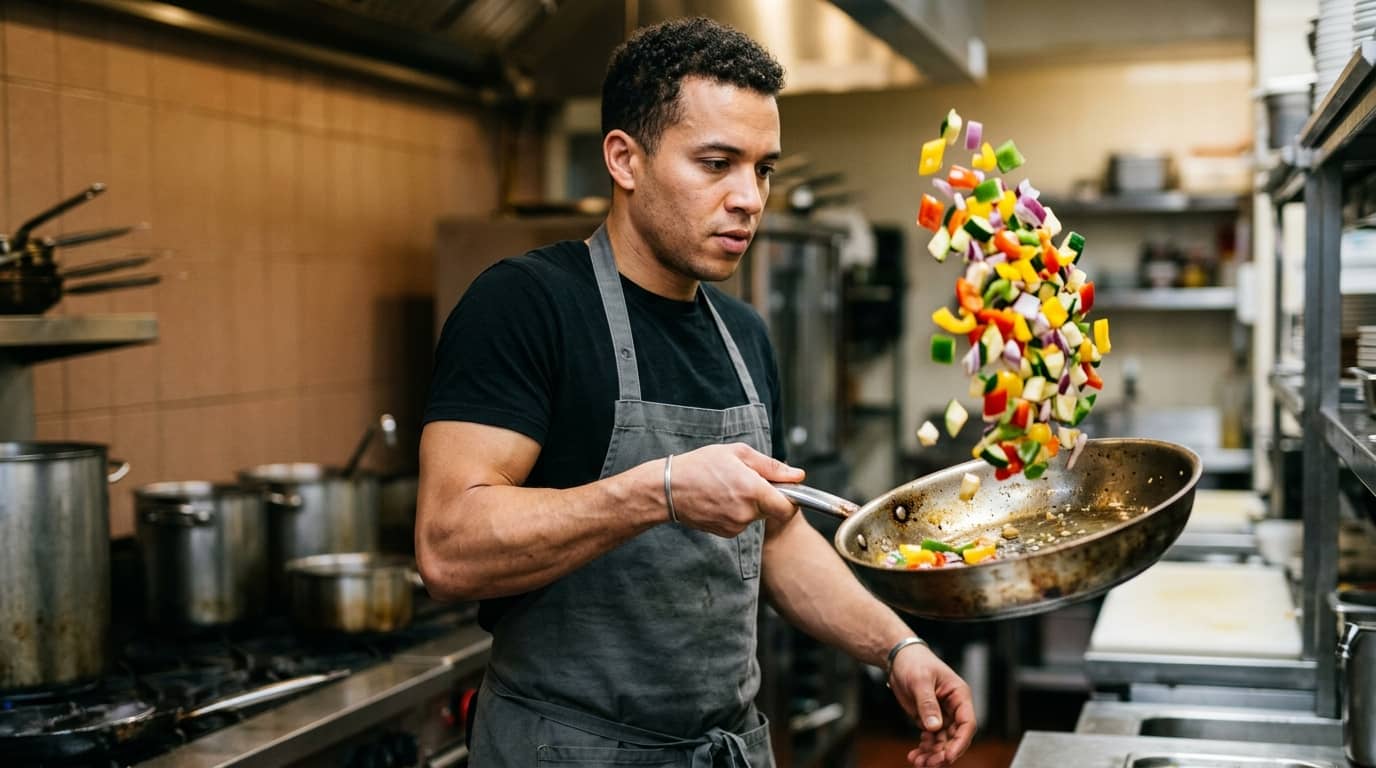
Basic Cooking Course
Learn to cook with real confidence, from knife skills and kitchen safety to sauces, baking, and global flavours. This course covers everything a beginner needs to go from uncertain to capable in the kitchen. You will build practical skills that make every meal better, faster, and more enjoyable.
What you'll learn:
You will start with kitchen safety, food hygiene, and essential tools, then move into knife skills, heat control, and seasoning fundamentals. The course walks you through moist-heat and dry-heat cooking methods, including braising, roasting, sautéing, and grilling. You will build classic sauces and soups from scratch using homemade stocks. Baking is covered in full, from yeast breads and pie crusts to cakes and biscuits. Supplementary lessons cover nutrition, budget cooking, meal planning, and food presentation so you can cook smarter every day.
How you study in practice Basic Cooking Course
How you practise Basic Cooking Course
For businesses looking to train their team
With Elevify for businesses, the course includes exercises and examples tailored to your own business and the way your company needs.

Course content
8 Chapters • 36 LessonsDuration between 4 and 360 hours (you decide)
Chapter 1HideHide detailsSee detailsKitchen Safety and Food Hygiene
Kitchen Safety and Food Hygiene
Lesson 1 • Kitchen Hazard Awareness
Addresses burns, cuts, slips, and fire risks common in cooking environments. Connects physical safety to uninterrupted, productive kitchen work.
Lesson 2 • Food Storage and Temperature Control
Teaches safe temperature zones, refrigerator organisation, and labelling. Prevents bacterial growth before food ever reaches the stove.
Lesson 3 • Personal Hygiene for Food Handlers
Covers handwashing technique, protective clothing, and illness policies. Anchors the chapter by establishing the cook as the first contamination risk.
Lesson 4 • Cross-Contamination Prevention
Identifies pathways by which pathogens transfer between foods and surfaces. Students apply colour-coded cutting board systems and proper surface sanitation.
Chapter 2HideHide detailsSee detailsEssential Kitchen Tools and Equipment
Essential Kitchen Tools and Equipment
Lesson 1 • Knife Maintenance and Sharpening
Teaches honing, sharpening, and proper storage to preserve blade performance. A sharp knife is reinforced as a safety and efficiency tool.
Lesson 2 • Knife Types and Their Uses
Introduces the chef's knife, paring knife, serrated knife, and specialty blades. Students match each knife to appropriate cutting tasks.
Lesson 3 • Cookware and Bakeware Selection
Compares materials such as stainless steel, cast iron, and nonstick for heat performance. Students choose appropriate pans for specific cooking methods.
Lesson 4 • Measuring and Prep Tools
Covers dry and liquid measuring tools, thermometers, and prep equipment. Accurate measurement is positioned as the foundation of consistent results.
Lesson 5 • Small Appliances and Their Functions
Surveys blenders, food processors, stand mixers, and other countertop tools. Students identify when appliances save time versus when manual methods are preferred.
Chapter 3HideHide detailsSee detailsKnife Skills and Basic Prep Techniques
Knife Skills and Basic Prep Techniques
Lesson 1 • Vegetable and Fruit Preparation
Applies cutting techniques to common produce, including round, irregular, and delicate items. Students learn to break down onions, citrus, avocados, and root vegetables.
Lesson 2 • Basic Protein Fabrication
Introduces trimming, portioning, and butterflying chicken, beef, and fish. Proper fabrication reduces waste and promotes even cooking.
Lesson 3 • Proper Knife Grip and Stance
Establishes the pinch grip, guide hand position, and stable body stance. Correct form reduces fatigue and prevents the most common knife injuries.
Lesson 4 • Fundamental Cutting Techniques
Covers slicing, dicing, mincing, chiffonade, and julienne cuts. Each technique is linked to specific recipes and cooking outcomes.
Chapter 4HideHide detailsSee detailsHeat, Flavour, and Seasoning Fundamentals
Heat, Flavour, and Seasoning Fundamentals
Lesson 1 • Acid, Fat, and Sweetness in Balance
Teaches how acid brightens, fat carries flavour, and sweetness balances bitterness. Students taste and adjust dishes using these four levers.
Lesson 2 • Herbs, Spices, and Aromatics
Distinguishes fresh from dried herbs, whole from ground spices, and introduces aromatic bases. Students build flavour foundations using onion, garlic, and celery.
Lesson 3 • Salt: The Primary Seasoning Tool
Covers salt types, timing of application, and its role in drawing out moisture and enhancing flavour. Students season in layers rather than only at the end.
Lesson 4 • How Heat Transforms Food
Explains the Maillard reaction, caramelisation, protein denaturation, and starch gelatinisation. Students predict texture and colour changes based on temperature and time.
Chapter 5HideHide detailsSee detailsMoist-Heat Cooking Methods
Moist-Heat Cooking Methods
Lesson 1 • Simmering and Poaching
Distinguishes simmering from boiling and applies gentle poaching to eggs, fish, and chicken. Controlled low heat preserves delicate textures.
Lesson 2 • Stocks and Broths
Produces chicken, beef, vegetable, and fish stocks as the foundation of soups and sauces. Students extract maximum flavour through proper ratio, time, and skimming.
Lesson 3 • Steaming Techniques
Teaches stovetop and bamboo steaming for vegetables, fish, and dumplings. Students retain nutrients and natural colour through proper steam management.
Lesson 4 • Braising and Stewing
Applies long, slow moist heat to tough cuts, converting collagen to gelatin for rich, tender results. Students build layered flavour through browning before braising.
Lesson 5 • Boiling and Blanching
Covers full rolling boils for pasta and grains and blanching for colour retention and par-cooking. Students control timing to avoid overcooking.
Chapter 6HideHide detailsSee detailsDry-Heat Cooking Methods
Dry-Heat Cooking Methods
Lesson 1 • Grilling and Broiling
Teaches direct and indirect grilling and oven broiling for charred, flavoursome results. Students control flare-ups, grill marks, and internal doneness.
Lesson 2 • Roasting Vegetables and Proteins
Applies dry oven heat to develop caramelisation and concentrated flavour in vegetables and large cuts. Students manage oven temperature, rack position, and resting time.
Lesson 3 • Sautéing and Stir-Frying
Uses high heat and minimal fat to cook small, uniform pieces quickly. Students manage pan temperature to achieve browning without steaming.
Lesson 4 • Pan-Frying and Shallow Frying
Covers breading, oil depth, and temperature management for crispy, evenly cooked results. Students learn to drain, rest, and season fried foods properly.
Chapter 7HideHide detailsSee detailsSauces, Soups, and Salads
Sauces, Soups, and Salads
Lesson 1 • Soups: Clear and Cream-Based
Produces consommé, vegetable soup, and cream soups using stocks built in the previous chapter. Students adjust body, seasoning, and garnish for each style.
Lesson 2 • Salad Composition and Dressings
Teaches green, composed, and grain salads alongside creamy and vinaigrette dressings. Students balance texture, colour, and flavour in every salad.
Lesson 3 • Tomato and Espagnole Sauces
Builds tomato sauce from fresh and canned tomatoes and espagnole from brown stock and mirepoix. Students reduce and season each sauce to proper consistency.
Lesson 4 • Roux-Based Sauces
Produces béchamel and velouté from roux and stock, then extends them into derivative sauces. Students control thickness by adjusting roux-to-liquid ratios.
Lesson 5 • Emulsified Sauces
Covers hollandaise and vinaigrette as warm and cold emulsions. Students understand emulsification science and rescue broken sauces.
Chapter 8HideHide detailsSee detailsBaking and Pastry Fundamentals
Baking and Pastry Fundamentals
Lesson 1 • Baking Science and Ingredient Roles
Explains how flour, leaveners, fats, eggs, and sugar interact during baking. Students predict how ingredient changes affect texture, rise, and browning.
Lesson 2 • Quick Breads and Muffins
Applies the muffin method and biscuit method to produce tender quick breads. Students avoid overmixing to prevent tough, dense results.
Lesson 3 • Basic Cakes and Cookies
Applies the creaming method for cakes and the drop method for cookies. Students calibrate oven temperature and baking time for consistent results.
Lesson 4 • Yeast Bread Basics
Covers yeast activation, kneading, proofing, and baking a basic white loaf. Students recognise proper dough texture and fermentation signs.
Lesson 5 • Pastry Doughs and Pie Crusts
Produces flaky pie dough and pâte brisée using the fat-cutting method. Students manage gluten development and chilling to achieve tender, flaky layers.

Your valid completion certificate
This course is for you:
College students: ready to move beyond instant meals and basic survival cooking.
New parents: motivated to prepare wholesome, home-cooked meals for their families.
Young professionals: tired of relying on takeaway and wanting genuine kitchen independence.
Aspiring food service workers: building foundational skills before entering a professional kitchen.
Home entertainers: eager to host dinners with dishes that genuinely impress guests.
Budget-conscious adults: determined to eat well whilst spending less money on food.
What our students say
Hear from those who've already studied with us:
Your lessons are perfect. I purchased the one-year package and finally have the opportunity to follow various topics of interest without needing to change platforms... I'm grateful for everything you do, I've already recommended you to other people...

I like how the lessons are straight to the point and how I can change chapters and skip content I don't need.

I like the content and the way videos are presented and transcribed, which speeds up the process!

The platform is fast and simple to use. The diversity of content and complementary videos really help with learning.

Top upskilling courses





FAQ
Who is Elevify? How does it work?
Do the courses have certificates?
Are the courses free?
What is the course workload?
What are the courses like?
How do the courses work?
What is the duration of the courses?
What is the cost or price of the courses?
What is an EAD or online course and how does it work?
PDF Course