
Agricultural Drone Operator Course
Launch a professional career in agricultural drone operations with the skills that modern farms demand. This course covers everything from flight fundamentals and precision spraying to crop mapping and business strategy. Whether you're entering the industry or expanding your services, you'll graduate ready to operate, maintain, and monetise agricultural drones with confidence.
What you'll learn:
You'll master drone hardware, flight controls, and manual piloting before moving into autonomous mission planning and precision spray operations. The course covers multispectral remote sensing, orthomosaic processing, and vegetation index analysis so you can deliver actionable crop health reports to growers. You'll also learn regulatory compliance, chemical handling, insurance requirements, and airspace authorisation. Maintenance routines, battery management, and field troubleshooting keep your equipment mission-ready. Advanced modules cover variable-rate application, fleet coordination, and drone service business planning so you can build a scalable, profitable operation.
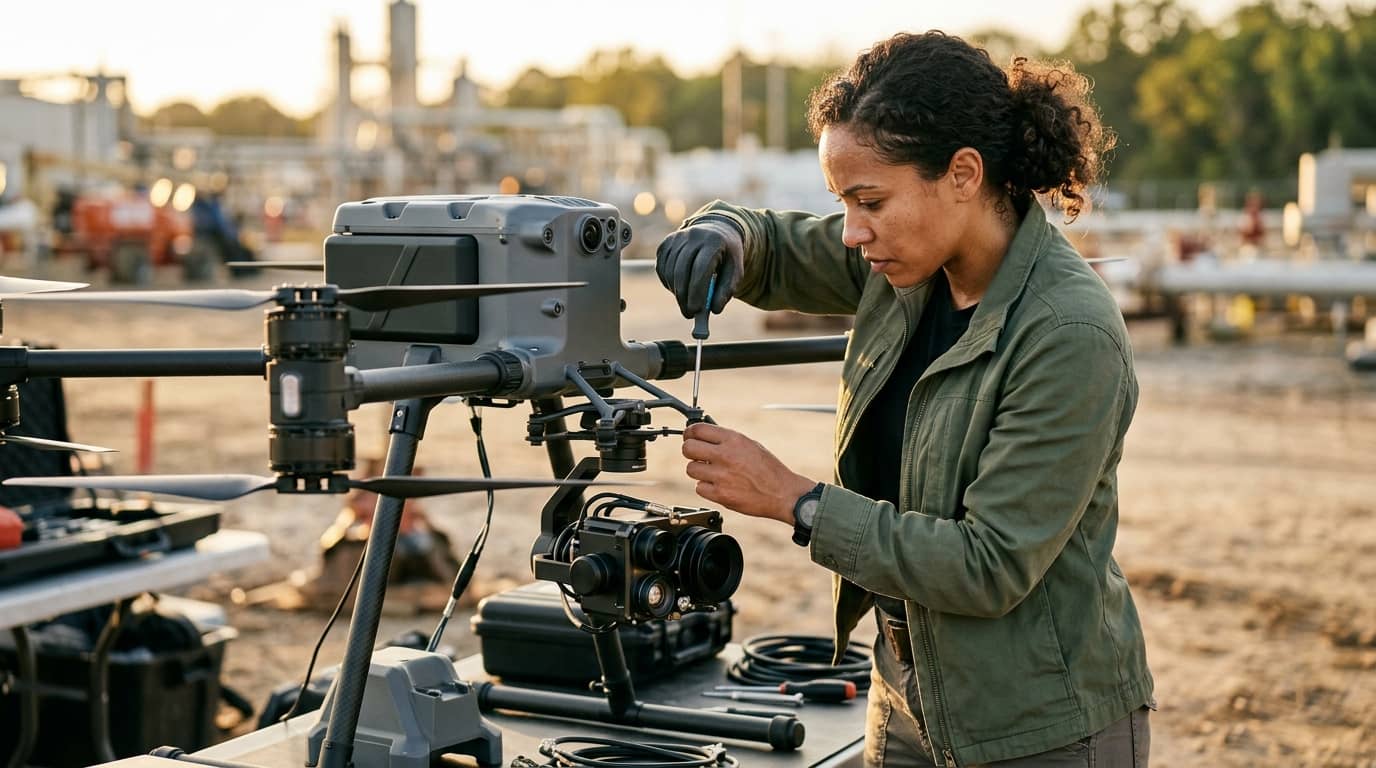
How you study in practice Agricultural Drone Operator Course
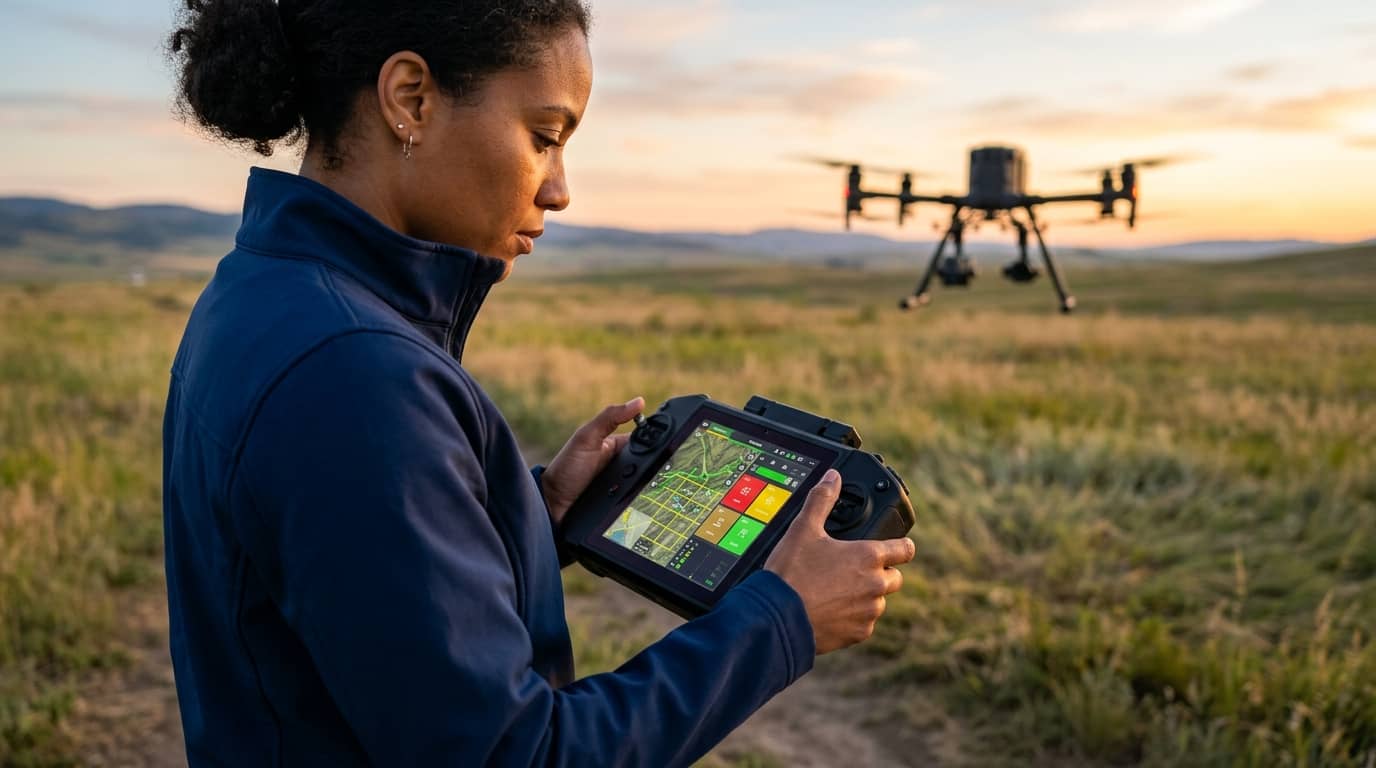
How you practise Agricultural Drone Operator Course
For businesses looking to train their team
With Elevify for businesses, the course includes exercises and examples tailored to your own business and the way your company needs.

Course content
8 Chapters • 40 LessonsDuration between 4 and 360 hours (you decide)
Chapter 1HideHide detailsSee detailsFoundations of Agricultural Drones
Foundations of Agricultural Drones
Lesson 1 • Drone Hardware and Components
Examines airframe, propulsion, power, and control systems. Understanding hardware enables informed equipment selection and basic troubleshooting.
Lesson 2 • Overview of Agricultural Use Cases
Maps drone capabilities to specific crop production tasks such as spraying, seeding, and scouting. Connects hardware knowledge to real-world operational goals.
Lesson 3 • Agricultural Payload Systems
Introduces spray tanks, spreaders, multispectral cameras, and LiDAR payloads. Payload selection directly determines mission capability and crop outcomes.
Lesson 4 • Ground Control and Communication Systems
Explains remote controllers, ground control stations, and telemetry links. Reliable communication is essential for safe and effective field operations.
Lesson 5 • Introduction to Agricultural Drone Technology
Covers the history and evolution of drones in farming contexts. Establishes baseline vocabulary and conceptual framework for the entire course.
Chapter 2HideHide detailsSee detailsRegulatory Compliance and Safety Standards
Regulatory Compliance and Safety Standards
Lesson 1 • Insurance and Liability Management
Explains liability exposure, hull and liability insurance types, and contract risk clauses. Proper coverage protects operators from financial loss after incidents.
Lesson 2 • Airspace Classification and Authorisation
Teaches controlled, uncontrolled, and restricted airspace categories relevant to farmland. Operators must obtain correct authorisations before every flight.
Lesson 3 • Operational Safety Requirements
Details pre-flight checklists, personal protective equipment, and bystander safety protocols. Safety procedures reduce accident risk and demonstrate professional standards.
Lesson 4 • Drone Regulatory Frameworks
Outlines national and regional airspace authority structures and operator certification requirements. Compliance begins with understanding which rules apply to agricultural operations.
Lesson 5 • Pesticide and Chemical Regulations
Covers pesticide application licensing, label compliance, and drift regulations specific to aerial application. Aerial chemical use carries stricter oversight than ground-based methods.
Chapter 3HideHide detailsSee detailsFlight Fundamentals and Manual Control
Flight Fundamentals and Manual Control
Lesson 1 • Basic Hover and Orientation Exercises
Practises stationary hover, nose-in orientation, and slow positional corrections. These exercises build the muscle memory required for all field operations.
Lesson 2 • Emergency Procedures and Recovery
Prepares pilots for motor failure, GPS loss, and flyaway scenarios through simulation and drill. Rapid, correct emergency response prevents crashes and injuries.
Lesson 3 • Transmitter Controls and Flight Modes
Covers stick assignments, mode configurations, and flight mode switching. Mastery of transmitter inputs is prerequisite to safe manual flight.
Lesson 4 • Principles of Flight and Aerodynamics
Explains lift, thrust, drag, and torque as they apply to multirotor and fixed-wing drones. Physical principles underpin every control input a pilot makes.
Lesson 5 • Fundamental Flight Manoeuvres
Trains figure-eight patterns, square circuits, and coordinated turns at varying altitudes. Consistent manoeuvre execution translates directly to accurate field coverage.
Chapter 4HideHide detailsSee detailsMission Planning and Field Assessment
Mission Planning and Field Assessment
Lesson 1 • Weather and Environmental Assessment
Explains wind speed limits, temperature effects, and precipitation thresholds for safe operations. Environmental conditions directly affect spray drift, image quality, and flight stability.
Lesson 2 • Mission Planning Software Fundamentals
Introduces waypoint planning, flight path generation, and overlap settings in planning applications. Software proficiency converts field data into executable flight instructions.
Lesson 3 • Flight Parameter Optimisation
Covers altitude, speed, and swath width trade-offs for spray and mapping missions. Optimised parameters balance coverage quality, battery life, and application accuracy.
Lesson 4 • Risk Assessment and Contingency Planning
Applies structured risk matrices to identify hazards and define go/no-go criteria. Documented contingency plans ensure safe responses to unexpected field conditions.
Lesson 5 • Field Survey and Site Assessment
Teaches physical site inspection, obstacle identification, and soil and crop condition evaluation. Accurate site data is the starting point for every mission plan.
Chapter 5HideHide detailsSee detailsPrecision spraying operations
Precision spraying operations
Lesson 1 • Drift management and buffer compliance
Explains droplet size selection, wind-adjusted flight paths, and buffer zone enforcement. Drift control protects neighbouring crops, water bodies, and non-target organisms.
Lesson 2 • Spray system setup and calibration
Covers nozzle selection, pump calibration, and flow rate verification before each mission. Correct calibration ensures label-compliant application rates and minimises waste.
Lesson 3 • Spray mission execution
Guides pilots through autonomous spray flight, real-time monitoring, and mid-mission adjustments. Consistent execution delivers uniform coverage across variable field conditions.
Lesson 4 • Application quality verification
Uses water-sensitive paper, coverage maps, and field scouting to confirm spray uniformity. Verification data supports agronomic decisions and client reporting.
Lesson 5 • Chemical handling and mixing protocols
Trains safe pesticide and fertiliser handling, dilution calculations, and spill response. Proper chemical management protects operators, crops, and the surrounding environment.
Chapter 6HideHide detailsSee detailsRemote sensing and crop mapping
Remote sensing and crop mapping
Lesson 1 • Remote sensing principles for agriculture
Introduces electromagnetic spectrum, reflectance, and vegetation indices relevant to crop monitoring. Conceptual grounding enables correct sensor selection and data interpretation.
Lesson 2 • Mapping mission planning and execution
Covers GSD targets, overlap settings, and calibration panel use for mapping flights. Proper planning ensures image quality sufficient for accurate orthomosaic production.
Lesson 3 • Vegetation index map interpretation
Analyses NDVI, NDRE, and CWSI maps to identify stress zones, nutrient deficiencies, and pest pressure. Map interpretation connects remote sensing data to agronomic action.
Lesson 4 • Photogrammetry and orthomosaic processing
Trains image stitching, point cloud generation, and orthomosaic export using processing software. Processed outputs form the spatial foundation for all crop analysis.
Lesson 5 • Delivering crop intelligence reports
Structures findings into client-ready reports with maps, recommendations, and supporting data. Clear reporting translates technical outputs into grower decisions.
Chapter 7HideHide detailsSee detailsDrone maintenance and troubleshooting
Drone maintenance and troubleshooting
Lesson 1 • Electronic and firmware troubleshooting
Diagnoses flight controller errors, sensor faults, and communication failures using log analysis. Systematic electronic diagnosis minimises repair time and prevents repeat failures.
Lesson 2 • Pre- and post-flight inspection routines
Establishes structured checklists for airframe, propulsion, payload, and electronics inspection. Consistent inspection habits catch faults before they cause mission failures.
Lesson 3 • Spray system maintenance
Details nozzle cleaning, pump servicing, tank flushing, and seal replacement schedules. Chemical residue buildup is the leading cause of spray system malfunction.
Lesson 4 • Field repair and spare parts management
Prepares operators to perform field-level repairs and manage a strategic spare parts inventory. Field repair capability keeps operations running during remote or time-critical missions.
Lesson 5 • Battery management and storage
Covers charge cycles, storage voltage, temperature limits, and battery retirement criteria. Proper battery management is the single largest factor in preventing power-related failures.
Chapter 8HideHide detailsSee detailsAdvanced operations and business strategy
Advanced operations and business strategy
Lesson 1 • Integration with farm management systems
Covers data export formats, API connections, and workflow integration with farm management platforms. Seamless data flow increases client value and reduces manual data handling.
Lesson 2 • Agronomic ROI measurement
Quantifies yield impact, input savings, and labour cost reduction attributable to drone operations. ROI evidence supports client retention and justifies service pricing.
Lesson 3 • Multi-drone fleet operations
Trains coordination of simultaneous multi-drone missions, crew roles, and fleet scheduling. Fleet operations multiply coverage capacity and require structured team management.
Lesson 4 • Drone service business planning
Guides pricing strategy, service package design, client acquisition, and operational scaling. A sound business plan converts technical skill into a sustainable commercial enterprise.
Lesson 5 • Variable-Rate Application Technology
Connects prescription maps to variable-rate spray and seeding systems for site-specific management. Variable-rate capability differentiates advanced operators and maximizes input efficiency.

Your valid completion certificate
This course is for you:
Farm worker: wants to add high-demand drone skills to daily field responsibilities.
Agronomist: seeks remote sensing tools to strengthen crop health recommendations.
Agricultural contractor: looks to offer drone spraying as a new revenue service.
Drone hobbyist: ready to convert recreational flying into a paid agricultural career.
Rural entrepreneur: aiming to build a local drone service business from scratch.
Crop consultant: needs data-driven mapping tools to better serve grower clients.
What our students say
Hear from those who've already studied with us:
Your lessons are perfect. I purchased the one-year package and finally have the opportunity to follow various topics of interest without needing to change platforms... I'm grateful for everything you do, I've already recommended you to other people...

I like how the lessons are straight to the point and how I can change chapters and skip content I don't need.

I like the content and the way videos are presented and transcribed, which speeds up the process!

The platform is fast and simple to use. The diversity of content and complementary videos really help with learning.

Top upskilling courses










FAQ
Who is Elevify? How does it work?
Do the courses have certificates?
Are the courses free?
What is the course workload?
What are the courses like?
How do the courses work?
What is the duration of the courses?
What is the cost or price of the courses?
What is an EAD or online course and how does it work?
PDF Course