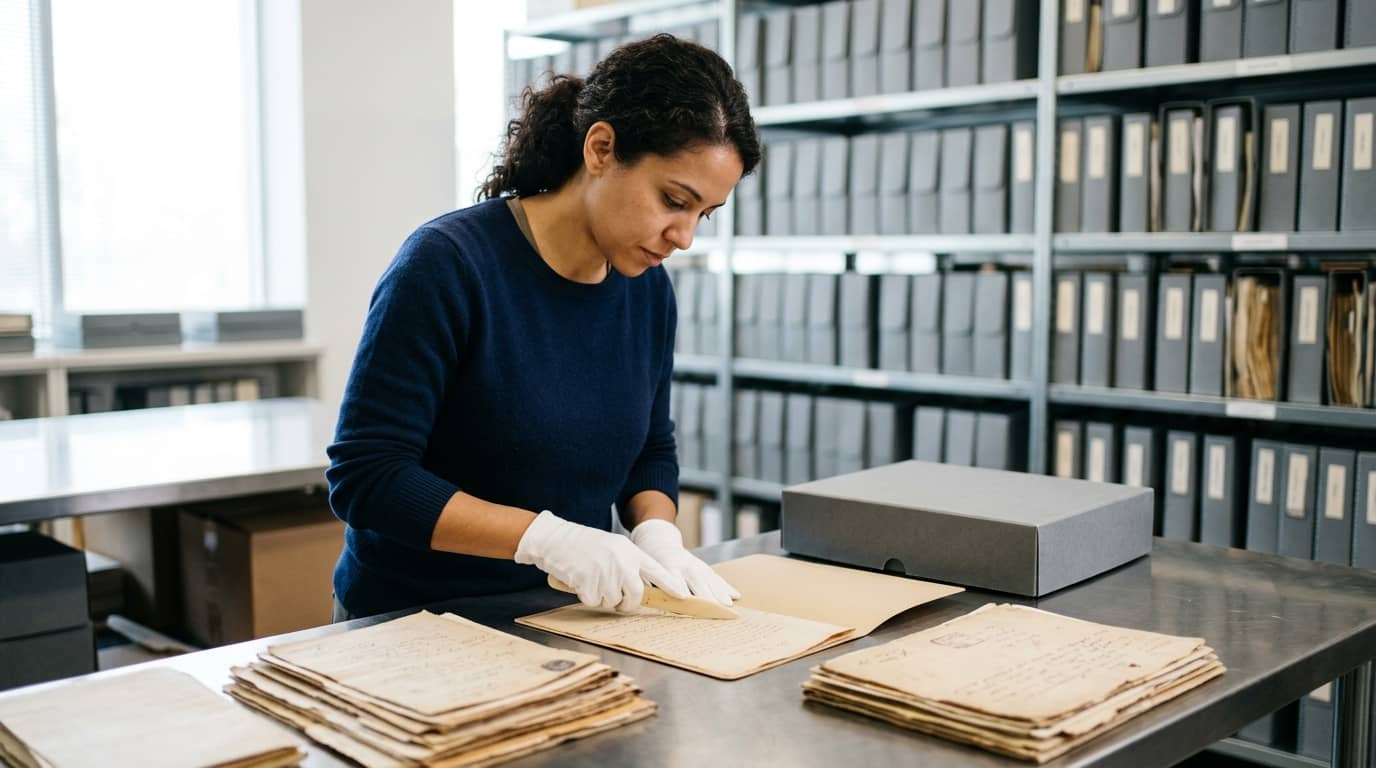
Archivist-Documentalist Training
Master the full spectrum of archival and records management practice, from foundational principles to digital preservation and programme strategy. This training equips you with the technical skills, ethical grounding, and administrative expertise employers expect from a credentialed archivist-documentalist. Whether you're entering the field or formalising years of experience, this course delivers the competencies that matter.
What you'll learn:
You will build a thorough understanding of archival science, covering core concepts such as provenance, original order, and the records lifecycle. You will learn how to appraise, arrange, and describe collections using internationally recognised standards, and how to manage both physical and born-digital records. The course addresses preservation planning, disaster preparedness, and trusted digital repository frameworks. You will also develop practical skills in reference services, legal compliance, digitisation programme design, and stakeholder advocacy. By the end, you will be prepared to plan and manage a complete archival programme from acquisition through long-term access.
How you study in practice Archivist-Documentalist Training
How you practise Archivist-Documentalist Training
For businesses looking to train their team
With Elevify for businesses, the course includes exercises and examples tailored to your own business and the way your company needs.

Course content
8 Chapters • 38 LessonsDuration between 4 and 360 hours (you decide)
Chapter 1HideHide detailsSee detailsFoundations of Archival Science
Foundations of Archival Science
Lesson 1 • History and Purpose of Archives
Traces archival practice from ancient record-keeping to modern institutions. Grounds students in the social and administrative functions archives serve.
Lesson 2 • Types of Archival Materials
Surveys textual, audiovisual, cartographic, and born-digital record types. Prepares students to identify and handle diverse holdings.
Lesson 3 • The Archival Profession and Ethics
Introduces professional codes of ethics, neutrality, and duty of care. Establishes the values guiding all archival decisions.
Lesson 4 • Core Archival Concepts and Terminology
Defines provenance, original order, fonds, and related terms. Provides the shared vocabulary used throughout all subsequent chapters.
Chapter 2HideHide detailsSee detailsRecords Management Fundamentals
Records Management Fundamentals
Lesson 1 • Disposition and Transfer Procedures
Details secure destruction, transfer to archives, and documentation of disposition actions. Ensures students can execute and audit disposition decisions.
Lesson 2 • Classification and File Plan Design
Teaches functional and subject-based classification schemes for organising records. Students design a file plan aligned with organisational functions.
Lesson 3 • Vital Records and Business Continuity
Identifies records critical to organisational survival and recovery. Students create a vital records protection plan.
Lesson 4 • Retention Scheduling
Covers how to set legally defensible retention periods based on regulatory and operational requirements. Students draft a retention schedule for a sample organisation.
Lesson 5 • The Records Lifecycle Model
Explains creation, active use, semi-active storage, and final disposition stages. Links lifecycle thinking to archival appraisal decisions covered later.
Chapter 3HideHide detailsSee detailsArchival Appraisal and Acquisition
Archival Appraisal and Acquisition
Lesson 1 • Theories of Archival Appraisal
Compares macro-appraisal, functional appraisal, and documentation strategy approaches. Equips students to choose the right methodology for different institutional contexts.
Lesson 2 • Conducting an Appraisal Survey
Guides students through surveying a record creator's functions, records, and context. Produces a written appraisal report as a practical deliverable.
Lesson 3 • Acquisition Policies and Collecting Scope
Explains how institutions define collecting mandates and avoid duplication with peer repositories. Students draft an acquisition policy statement.
Lesson 4 • Legal and Ethical Dimensions of Acquisition
Addresses provenance of ownership, cultural property concerns, and deed of gift requirements. Ensures legally sound and ethically defensible acquisitions.
Chapter 4HideHide detailsSee detailsArrangement and Description of Archives
Arrangement and Description of Archives
Lesson 1 • Quality Control in Description
Establishes review workflows, consistency checks, and error correction procedures. Ensures finding aids meet institutional and user quality standards.
Lesson 2 • Descriptive Standards and Schemas
Introduces internationally recognised descriptive standards for archival content and authority records. Students map local practice to standard elements.
Lesson 3 • Writing Archival Finding Aids
Teaches scope and content notes, biographical histories, and container lists. Students draft a complete finding aid for a processed collection.
Lesson 4 • Principles of Archival Arrangement
Applies provenance and original order to multi-level arrangement decisions. Students arrange a sample accession from fonds level to item level.
Lesson 5 • Minimal Processing and Extensible Processing
Balances thorough description against backlogs using tiered processing strategies. Students prioritise processing levels based on collection significance and resources.
Chapter 5HideHide detailsSee detailsPreservation and Conservation of Records
Preservation and Conservation of Records
Lesson 1 • Disaster Preparedness and Recovery
Builds skills in writing disaster plans, salvage priorities, and post-disaster recovery. Students complete a disaster response exercise for a simulated emergency.
Lesson 2 • Environmental Controls and Storage
Specifies optimal storage conditions and enclosure standards for different record formats. Students audit a sample storage area and recommend improvements.
Lesson 3 • Agents of Deterioration
Identifies physical, chemical, biological, and human threats to archival materials. Provides the diagnostic foundation for all preservation interventions.
Lesson 4 • Conservation Treatment Principles
Covers stabilisation, cleaning, repair, and the ethics of minimal intervention. Distinguishes archivist responsibilities from conservator specialist work.
Lesson 5 • Preservation Assessment and Planning
Guides systematic condition surveys and the development of a preservation plan. Prioritises interventions based on risk and institutional resources.
Chapter 6HideHide detailsSee detailsDigital Preservation and Electronic Records
Digital Preservation and Electronic Records
Lesson 1 • Managing Email and Collaborative Platforms
Addresses capture, appraisal, and preservation of email, shared drives, and collaboration tools. Applies digital preservation principles to high-volume, complex record types.
Lesson 2 • Trusted Digital Repository Standards
Introduces open archival information system concepts and repository audit criteria. Students assess a repository against a recognised trustworthiness framework.
Lesson 3 • Characteristics of Electronic Records
Analyses authenticity, reliability, integrity, and usability requirements for digital records. Establishes why digital preservation differs fundamentally from analogue preservation.
Lesson 4 • Ingest and Processing of Digital Records
Covers virus checking, checksum verification, format identification, and metadata extraction. Students process a sample digital accession through an ingest workflow.
Lesson 5 • Digital Preservation Strategies
Compares migration, emulation, normalisation, and format standardisation approaches. Students select and justify a strategy for a given digital collection.
Chapter 7HideHide detailsSee detailsReference Services and Access Management
Reference Services and Access Management
Lesson 1 • Reference Interview and Research Assistance
Teaches techniques for understanding researcher needs and guiding effective archival searches. Students conduct and evaluate mock reference interviews.
Lesson 2 • Reading Room Operations
Covers registration, supervision, handling rules, and reproduction policies for on-site access. Ensures safe and orderly researcher access to original materials.
Lesson 3 • Restricted and Sensitive Records Management
Addresses redaction, access review workflows, and managing classified or sensitive materials. Students apply an access review process to a sample restricted collection.
Lesson 4 • Principles of Archival Access
Balances the right to access with privacy, confidentiality, and donor restrictions. Establishes the ethical and legal framework for all reference decisions.
Lesson 5 • Online Access and Discovery Systems
Examines online finding aid portals, aggregated discovery platforms, and search optimisation. Students configure a sample collection for online discovery.
Chapter 8HideHide detailsSee detailsArchival Programme Management and Strategy
Archival Programme Management and Strategy
Lesson 1 • Budgeting and Resource Management
Covers budget preparation, cost justification, and resource allocation for archival operations. Students build a sample operating budget with narrative justification.
Lesson 2 • Staffing, Training, and Supervision
Addresses hiring, onboarding, performance management, and professional development for archival staff. Builds capacity to lead a diverse archival team.
Lesson 3 • Advocacy and Stakeholder Engagement
Builds skills in communicating archival value to administrators, funders, and the public. Students develop an advocacy campaign for a specific archival programme.
Lesson 4 • Strategic Planning for Archives
Applies environmental scanning, mission alignment, and goal-setting to archival programme development. Produces a multi-year strategic plan as a capstone deliverable.
Lesson 5 • Policy Development and Governance
Guides drafting, approving, and reviewing operational policies for all archival functions. Students produce a policy suite covering key repository operations.

Your valid completion certificate
This course is for you:
Library or museum staff: seeking to expand into archival roles and responsibilities.
Records coordinators: wanting formal grounding to validate their hands-on workplace experience.
History graduates: looking to translate academic training into an information profession career.
Local government employees: responsible for public records with no specialised archival preparation.
Genealogists and researchers: eager to understand how archives are organised and professionally managed.
Career changers: drawn to document preservation and ready to build expertise from the ground up.
What our students say
Hear from those who've already studied with us:
Your lessons are perfect. I purchased the one-year package and finally have the opportunity to follow various topics of interest without needing to change platforms... I'm grateful for everything you do, I've already recommended you to other people...

I like how the lessons are straight to the point and how I can change chapters and skip content I don't need.

I like the content and the way videos are presented and transcribed, which speeds up the process!

The platform is fast and simple to use. The diversity of content and complementary videos really help with learning.

Top upskilling courses










FAQ
Who is Elevify? How does it work?
Do the courses have certificates?
Are the courses free?
What is the course workload?
What are the courses like?
How do the courses work?
What is the duration of the courses?
What is the cost or price of the courses?
What is an EAD or online course and how does it work?
PDF Course