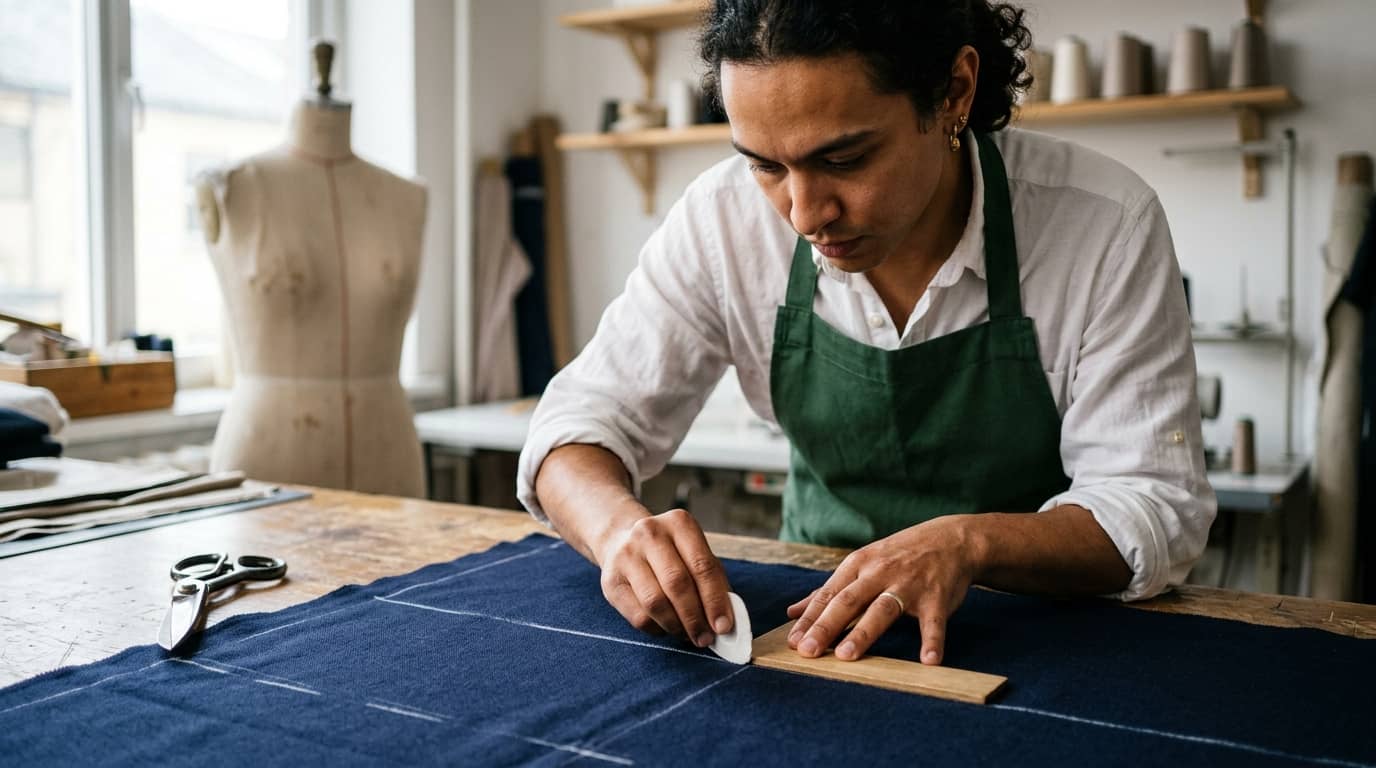
Basic Tailoring Course
Learn the full craft of tailoring, from selecting the right fabric to delivering a polished, wearable garment. This course covers every essential skill — tools, measurements, pattern alterations, construction, and professional finishing — in one structured programme. Whether you are starting from scratch or sharpening existing skills, you will build real, hands-on expertise that produces results you can wear and be proud of.
What you'll learn:
In this course, you will master the core skills that professional tailors use every day. You will learn to identify and handle tools correctly, set up a safe and efficient workspace, and select the right fabrics and notions for each project. You will take accurate body measurements, read and alter commercial patterns, and cut fabric with precision. Step by step, you will construct complete garments — including darts, sleeves, collars, waistbands, and closures — and finish them to a professional standard. You will also explore specialty techniques such as zipper installation, lining insertion, and final pressing.
How you study in practice Basic Tailoring Course
How you practise Basic Tailoring Course
For businesses looking to train their team
With Elevify for businesses, the course includes exercises and examples tailored to your own business and the way your company needs.

Course content
8 Chapters • 37 LessonsDuration between 4 and 360 hours (you decide)
Chapter 1HideHide detailsSee detailsIntroduction to Tailoring and Tools
Introduction to Tailoring and Tools
Lesson 1 • Workspace Organisation and Safety
Establishes ergonomic layout and safe practices for a tailoring workspace. Proper organisation reduces errors and prevents injury.
Lesson 2 • History and Scope of Tailoring
Covers the evolution of tailoring from bespoke craft to modern production. Establishes professional context and motivates disciplined technique.
Lesson 3 • Essential Sewing Tools
Identifies hand tools, cutting instruments, and pressing equipment used daily. Students practise correct grip and safe handling of each tool.
Lesson 4 • Sewing Machine Basics
Introduces machine anatomy, threading, and tension adjustment. Correct setup prevents common stitching errors throughout the course.
Chapter 2HideHide detailsSee detailsFabrics and Materials Selection
Fabrics and Materials Selection
Lesson 1 • Fabric Weave and Weight
Analyses plain, twill, and satin weaves and their effect on drape and durability. Weave structure determines cutting and sewing approach.
Lesson 2 • Fabric Preparation and Pre-treatment
Covers pre-washing, straightening grain, and pressing before cutting. Proper preparation prevents shrinkage and distortion in finished garments.
Lesson 3 • Fabric Fibre Types and Properties
Examines natural, synthetic, and blended fibres and their performance characteristics. Fibre knowledge guides appropriate fabric selection for each garment.
Lesson 4 • Notions and Trimmings
Surveys threads, zippers, buttons, and other notions needed to complete garments. Correct notion selection ensures durability and professional appearance.
Lesson 5 • Interfacing, Lining, and Underlining
Introduces support materials that give garments structure and finish. Students select the correct weight and type for each application.
Chapter 3HideHide detailsSee detailsBody Measurements and Fitting
Body Measurements and Fitting
Lesson 1 • Standard Size Charts and Grading
Compares individual measurements against industry size charts and introduces basic grading. Students learn to select the best starting pattern size.
Lesson 2 • Taking Accurate Body Measurements
Teaches a systematic sequence for measuring bust, waist, hips, and length points. Consistent technique ensures repeatable, reliable data.
Lesson 3 • Fitting Analysis and Adjustment Principles
Identifies common fit problems such as drag lines, pulling, and excess fabric. Students diagnose causes and plan corrections before cutting.
Lesson 4 • Anatomy Relevant to Garment Fit
Maps body landmarks used as measurement reference points. Understanding anatomy prevents misplaced seams and poor fit.
Chapter 4HideHide detailsSee detailsPattern Reading and Alteration
Pattern Reading and Alteration
Lesson 1 • Length and Width Alterations
Applies slash-and-spread and tuck methods to adjust pattern length and width. These techniques correct the most common fit discrepancies.
Lesson 2 • Pattern Tracing and Transfer
Demonstrates tracing patterns onto paper to preserve originals and enable alterations. Accurate transfer maintains pattern integrity.
Lesson 3 • Dart Manipulation and Relocation
Explains dart function and teaches pivot and slash methods to move or convert darts. Dart control shapes garments to body contours.
Lesson 4 • Anatomy of a Commercial Pattern
Decodes pattern symbols, grain lines, notches, and instruction sheets. Fluent pattern reading prevents cutting and construction errors.
Lesson 5 • Seam Allowance and Layout Planning
Covers adding, reducing, and marking seam allowances and planning efficient fabric layouts. Proper layout minimises waste and respects grain.
Chapter 5HideHide detailsSee detailsCutting and Marking Techniques
Cutting and Marking Techniques
Lesson 1 • Preparing Fabric for Cutting
Reviews grain alignment, folding, and pinning fabric before cutting. Correct preparation ensures pattern pieces cut true to grain.
Lesson 2 • Handling Specialty Fabrics When Cutting
Addresses cutting challenges with plaids, stripes, nap fabrics, and sheers. Special handling prevents mismatched patterns and distortion.
Lesson 3 • Cutting Tools and Techniques
Demonstrates scissor and rotary cutter techniques for straight and curved edges. Smooth, single-stroke cutting produces clean seam lines.
Lesson 4 • Marking Methods
Teaches chalk, tracing wheel, tailor's tacks, and thread tracing for transferring pattern marks. Accurate marks guide every construction step.
Chapter 6HideHide detailsSee detailsCore Hand and Machine Stitching
Core Hand and Machine Stitching
Lesson 1 • Machine Seam Types
Demonstrates plain, French, flat-felled, and lapped seams and their appropriate applications. Seam choice affects durability, bulk, and appearance.
Lesson 2 • Topstitching and Edge Stitching
Teaches decorative and functional topstitching for collars, cuffs, and edges. Consistent stitch distance elevates garment professionalism.
Lesson 3 • Stitching Curves, Corners, and Points
Addresses technique adjustments for sewing curved seams, inside corners, and sharp points. Mastery here determines garment shape accuracy.
Lesson 4 • Seam Finishing Methods
Covers pinked, zigzag, serged, and bound seam finishes to prevent fraying. Finish selection matches fabric type and garment end use.
Lesson 5 • Fundamental Hand Stitches
Teaches running, backstitch, slip stitch, and catch stitch for construction and finishing. Hand stitches provide control unavailable with machines.
Chapter 7HideHide detailsSee detailsGarment Construction Fundamentals
Garment Construction Fundamentals
Lesson 1 • Collar and Neckline Construction
Builds flat, stand, and shirt collars and attaches them to necklines cleanly. Collar construction tests precision in cutting, stitching, and pressing.
Lesson 2 • Hems and Edge Finishes
Covers blind hem, hand-rolled hem, and machine hem techniques for varied garment types. Hem choice affects drape, weight, and visual finish.
Lesson 3 • Waistbands and Waistline Finishes
Covers interfaced waistbands, faced waistlines, and elastic casings. Sturdy waistline construction supports garment shape and comfort.
Lesson 4 • Sleeve Setting and Cuff Attachment
Demonstrates easing, setting, and pressing sleeves into armholes and attaching cuffs. Smooth sleeve caps and flat cuffs signal professional skill.
Lesson 5 • Darts, Tucks, and Pleats
Constructs darts, tucks, and pleats that shape fabric to body contours. Precise stitching and pressing determine final garment silhouette.
Chapter 8HideHide detailsSee detailsClosures, Finishing, and Final Fitting
Closures, Finishing, and Final Fitting
Lesson 1 • Lining Insertion Techniques
Demonstrates bagged and hand-sewn lining methods for jackets and skirts. Proper lining improves drape, comfort, and interior finish.
Lesson 2 • Final Pressing and Garment Care
Applies professional pressing sequences to shape and set the finished garment. Correct pressing transforms a sewn garment into a tailored one.
Lesson 3 • Buttons, Buttonholes, and Snaps
Covers machine and hand-worked buttonholes, button sewing, and snap placement. Secure, evenly spaced closures complete garment function.
Lesson 4 • Zipper Installation Methods
Teaches centred, lapped, invisible, and fly-front zipper applications. Flat, pucker-free zippers are a benchmark of tailoring quality.
Lesson 5 • Final Fitting and Quality Inspection
Conducts a structured final fitting and systematic quality check against professional standards. Students identify and correct any remaining defects.

Your valid completion certificate
This course is for you:
Hobbyist sewers: ready to move beyond basic projects into structured garment-making.
Career changers: exploring tailoring as a viable trade or small business opportunity.
Fashion students: seeking hands-on construction skills to complement design coursework.
Home sewers: frustrated by poor-fitting store-bought clothes and wanting custom solutions.
Aspiring alterations specialists: looking to serve clients with professional-grade repair skills.
Craft entrepreneurs: wanting to offer made-to-measure garments as a marketable service.
What our students say
Hear from those who've already studied with us:
Your lessons are perfect. I purchased the one-year package and finally have the opportunity to follow various topics of interest without needing to change platforms... I'm grateful for everything you do, I've already recommended you to other people...

I like how the lessons are straight to the point and how I can change chapters and skip content I don't need.

I like the content and the way videos are presented and transcribed, which speeds up the process!

The platform is fast and simple to use. The diversity of content and complementary videos really help with learning.

Top upskilling courses








FAQ
Who is Elevify? How does it work?
Do the courses have certificates?
Are the courses free?
What is the course workload?
What are the courses like?
How do the courses work?
What is the duration of the courses?
What is the cost or price of the courses?
What is an EAD or online course and how does it work?
PDF Course