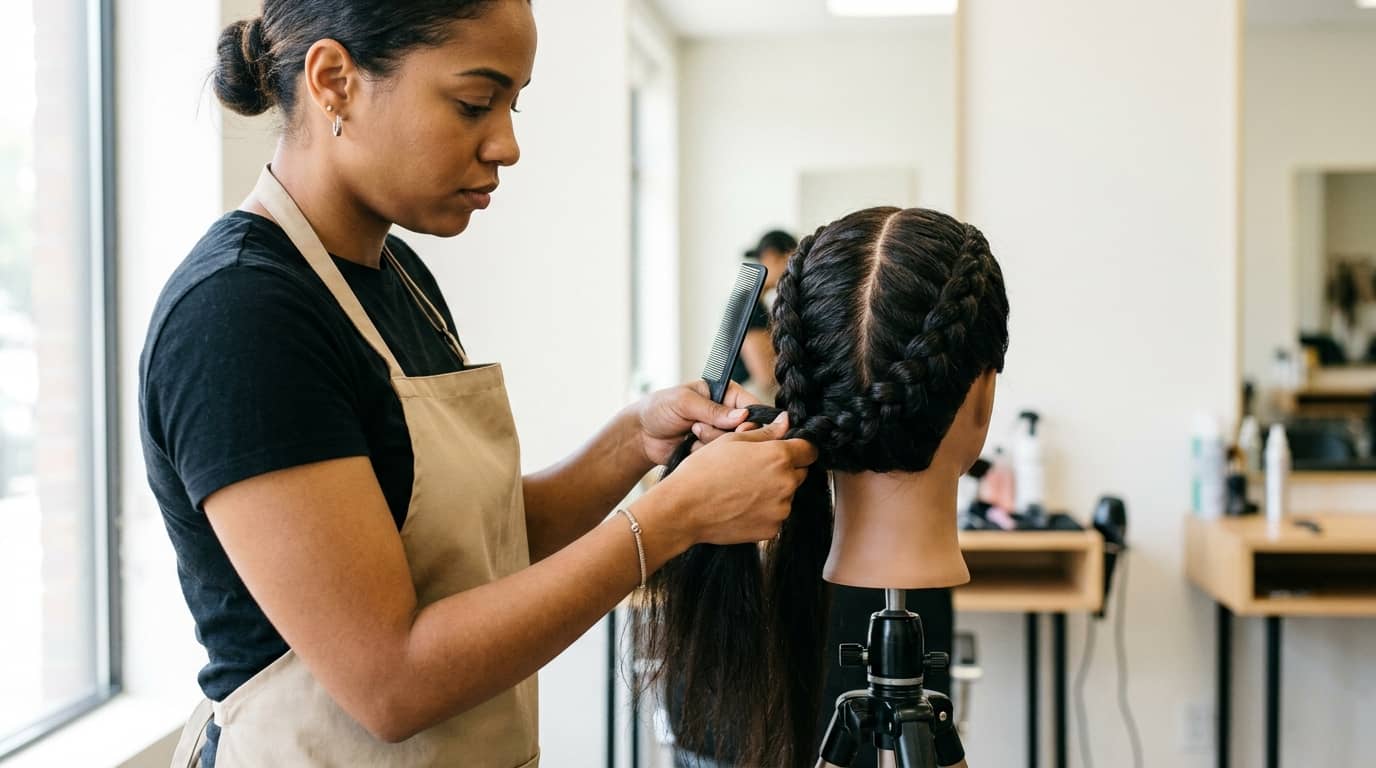
Beginners Braiding Course
Learn every essential braiding technique from the ground up, starting with the classic three-strand braid and building to cornrows, box braids, fishtails, and more. This course covers tools, hair prep, tension control, and client care so you finish ready to deliver real results. Whether you're braiding for yourself or building a clientele, this is where your skills start.
What you'll learn:
You'll start with workspace setup, tool selection, and hair preparation before moving into core techniques like the three-strand braid, French and Dutch braids, cornrows, and box braids with extensions. From there, you'll tackle fishtail and rope braids, learn how to design curved and geometric patterns, and practise finishing methods that make every style look polished. The course also covers scalp health, safe braid removal, and how to protect braids between appointments. Bonus chapters walk you through colour and texture choices, occasion-ready styles, and the business basics you need to start booking clients.
How you study in practice Beginners Braiding Course
How you practise Beginners Braiding Course
For businesses looking to train their team
With Elevify for businesses, the course includes exercises and examples tailored to your own business and the way your company needs.

Course content
8 Chapters • 40 LessonsDuration between 4 and 360 hours (you decide)
Chapter 1HideHide detailsSee detailsIntroduction to Braiding Fundamentals
Introduction to Braiding Fundamentals
Lesson 1 • History and Cultural Roots of Braiding
Traces braiding from ancient traditions to modern practice across cultures. Provides context that informs technique choices and design inspiration.
Lesson 2 • Setting Up Your Workspace
Covers ergonomic positioning, lighting, and supply organisation for a productive session. A well-arranged workspace reduces fatigue and errors.
Lesson 3 • Tools and Materials Overview
Identifies combs, clips, bands, and hair types suited to braiding. Proper tool selection directly impacts braid quality and efficiency.
Lesson 4 • Essential Braiding Vocabulary
Defines core terms used throughout the course, including strand, tension, and pattern. Shared vocabulary ensures clear communication during instruction.
Lesson 5 • Understanding Hair Texture and Type
Explains how curl pattern, porosity, and density affect braiding behaviour. Matching technique to hair type prevents breakage and improves results.
Chapter 2HideHide detailsSee detailsHair Preparation and Sectioning
Hair Preparation and Sectioning
Lesson 1 • Parting and Sectioning Methods
Teaches straight, diagonal, and curved parting using a rat-tail comb. Precise parts create symmetrical, professional-looking braids.
Lesson 2 • Applying Braiding Products
Reviews edge control, braiding cream, and oil use to enhance grip and shine. Correct product application supports tension without causing buildup.
Lesson 3 • Detangling Techniques and Tools
Demonstrates wide-tooth comb, finger detangling, and brush methods for various textures. Thorough detangling prevents knots that disrupt braid uniformity.
Lesson 4 • Cleansing and Conditioning for Braiding
Covers shampoo selection, deep conditioning, and detangling protocols suited to braiding. Clean, moisturised hair holds tension evenly and reduces frizz.
Lesson 5 • Tension Control Fundamentals
Introduces consistent grip pressure and hand positioning to maintain even tension. Balanced tension prevents scalp stress and uneven braid thickness.
Chapter 3HideHide detailsSee detailsThe Classic Three-Strand Braid
The Classic Three-Strand Braid
Lesson 1 • The Over-Under Crossing Pattern
Breaks down the alternating left-over-centre and right-over-centre crossing sequence. Mastering this pattern is the core motor skill of all braiding.
Lesson 2 • Common Mistakes and Corrections
Identifies crossing errors, loose tension, and uneven strands with corrective steps. Early error recognition builds self-correction habits essential for progress.
Lesson 3 • Dividing Hair into Three Equal Strands
Covers measuring and splitting a section into three equal parts before braiding begins. Equal strands are the prerequisite for a uniform finished braid.
Lesson 4 • Finishing and Securing the Braid
Demonstrates how to end a braid cleanly with a band and seal the tip. A secure finish prevents unravelling and extends braid longevity.
Lesson 5 • Maintaining Consistent Braid Size
Teaches how to keep each crossing the same size from root to end. Consistent size signals professional skill and improves overall braid appearance.
Chapter 4HideHide detailsSee detailsFrench and Dutch Braid Techniques
French and Dutch Braid Techniques
Lesson 1 • Starting the French Braid
Covers crown placement, initial three-strand split, and the first add-in crossing. A strong start determines the braid's direction and symmetry throughout.
Lesson 2 • Completing the Dutch Braid
Introduces the under-crossing variation that creates a raised, three-dimensional braid. Students practise the Dutch method alongside French to compare results.
Lesson 3 • Understanding Scalp Braid Mechanics
Explains how adding hair each pass differs from a standard braid in grip and tension. This conceptual shift prepares students for the added complexity of scalp braids.
Lesson 4 • Directional Variations and Paths
Explores side, diagonal, and curved braid paths across the scalp. Directional control expands design options and prepares students for complex layouts.
Lesson 5 • Incorporating Hair with Each Pass
Teaches how to pick up equal amounts of new hair before each crossing to maintain uniformity. Consistent add-ins prevent gaps and lumps along the braid line.
Chapter 5HideHide detailsSee detailsBox Braids and Individual Braids
Box Braids and Individual Braids
Lesson 1 • Braiding Down to the Tip
Guides students through maintaining even tension and size from root to tip with extensions. Consistent execution across all braids creates a polished, uniform finish.
Lesson 2 • Creating a Box Part Grid
Demonstrates how to map and execute a uniform square parting grid across the entire head. A consistent grid is the foundation of symmetrical box braids.
Lesson 3 • Sizing and Length Customisation
Explains how to adjust braid thickness and length to suit client preferences and hair density. Customisation skills differentiate a beginner from a skilled braider.
Lesson 4 • Finishing and Styling Box Braids
Covers dipping in hot water, trimming, and styling options like updos and ponytails. Finishing techniques elevate the look and demonstrate professional polish.
Lesson 5 • Adding Extension Hair
Covers folding, attaching, and blending synthetic or natural extension hair at the root. Proper attachment prevents slippage and creates a seamless look.
Chapter 6HideHide detailsSee detailsCornrow Braiding Techniques
Cornrow Braiding Techniques
Lesson 1 • Straight Cornrow Execution
Guides students through braiding parallel straight rows from hairline to nape. Straight rows build the muscle memory needed for more complex patterns.
Lesson 2 • Feed-In Cornrows with Extensions
Demonstrates gradually adding extension hair to build length and fullness in cornrows. Feed-in extensions create a natural-looking, seamless result.
Lesson 3 • Underhand Feed-In Method
Teaches the underhand crossing motion that keeps cornrows flat against the scalp. This technique is the defining skill that separates cornrows from other braids.
Lesson 4 • Cornrow Anatomy and Structure
Defines the base, body, and tip of a cornrow and how each part is formed. Understanding structure guides correct hand positioning throughout the braid.
Lesson 5 • Curved and Geometric Patterns
Introduces curved, circular, and angular cornrow designs using pre-planned part maps. Pattern planning before braiding prevents asymmetry and wasted effort.
Chapter 7HideHide detailsSee detailsFishtail and Rope Braid Variations
Fishtail and Rope Braid Variations
Lesson 1 • Two-Strand Braid Mechanics
Explains how two-strand braids differ structurally from three-strand versions in crossing logic. This conceptual foundation prevents confusion when switching between braid types.
Lesson 2 • Classic Fishtail Braid
Teaches the small-section alternating pull technique that creates the fishtail's herringbone look. Thin, even pulls are the key to a tight, defined fishtail pattern.
Lesson 3 • Scalp Fishtail Braid
Adapts the fishtail technique to the scalp by adding hair from each side with every pass. Scalp fishtails combine the complexity of French braids with the fishtail pattern.
Lesson 4 • Styling Fishtail and Rope Braids
Covers pancaking, pinning, and accessorising fishtail and rope braids for different occasions. Styling versatility makes these braids suitable for casual and formal settings.
Lesson 5 • Rope Braid Technique
Demonstrates twisting two strands in the same direction, then wrapping them around each other. The rope braid's twisted structure creates a distinct coiled texture.
Chapter 8HideHide detailsSee detailsBraid Maintenance and Client Care
Braid Maintenance and Client Care
Lesson 1 • Client Consultation and Communication
Teaches how to assess client needs, set realistic expectations, and explain aftercare clearly. Strong communication builds trust and encourages repeat clients.
Lesson 2 • Recognising Tension-Related Damage
Identifies signs of traction alopecia, scalp soreness, and follicle stress from tight braids. Early recognition allows intervention before permanent damage occurs.
Lesson 3 • Protecting Braids During Sleep
Explains satin bonnets, pillowcases, and wrapping methods to reduce frizz overnight. Nighttime protection significantly extends the lifespan of any braid style.
Lesson 4 • Safe Braid Removal Techniques
Demonstrates cutting, unravelling, and detangling methods that minimise breakage on removal. Proper removal preserves hair health for the next installation.
Lesson 5 • Scalp Care While Braided
Covers moisturising, oiling, and cleansing the scalp without disturbing installed braids. Consistent scalp care prevents dryness, itching, and buildup during wear.

Your valid completion certificate
This course is for you:
Beginners: eager to learn braiding with zero prior hands-on experience.
Stay-at-home parents: wanting a flexible, income-generating skill they can practise at home.
Cosmetology students: looking to add specialised braiding techniques to their existing training.
Hobbyists: passionate about hair styling and ready to move beyond basic ponytails.
Career changers: exploring beauty services as a low-barrier path to self-employment.
Caregivers: responsible for maintaining natural hair for children or family members daily.
What our students say
Hear from those who've already studied with us:
Your lessons are perfect. I purchased the one-year package and finally have the opportunity to follow various topics of interest without needing to change platforms... I'm grateful for everything you do, I've already recommended you to other people...

I like how the lessons are straight to the point and how I can change chapters and skip content I don't need.

I like the content and the way videos are presented and transcribed, which speeds up the process!

The platform is fast and simple to use. The diversity of content and complementary videos really help with learning.

Top upskilling courses







FAQ
Who is Elevify? How does it work?
Do the courses have certificates?
Are the courses free?
What is the course workload?
What are the courses like?
How do the courses work?
What is the duration of the courses?
What is the cost or price of the courses?
What is an EAD or online course and how does it work?
PDF Course