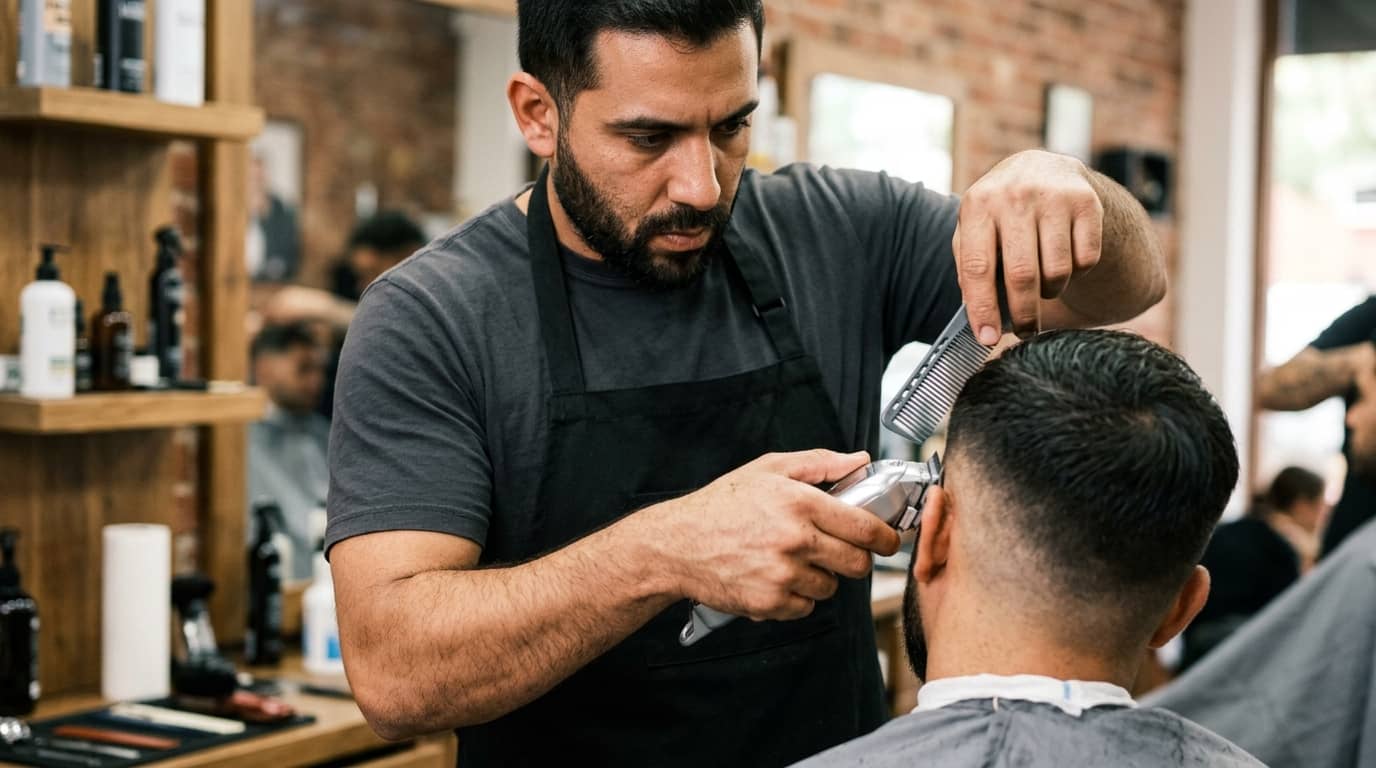
Beginner Men's Hair Cutting Course
Learn everything you need to start cutting men's hair the right way, from tool sanitation and clipper mechanics to fades, tapers, and classic styles. This beginner course covers the full barbering workflow so you build real, job-ready skills from day one. Whether you're starting a career or adding a serious skill set, this is where it begins.
What you'll learn:
This course takes you through every stage of a professional men's haircut, starting with hygiene standards, tool knowledge, and workstation setup. You'll study hair and scalp science so you can make smart decisions for every client who sits in your chair. From there, you'll develop hands-on clipper and scissor techniques, including guard work, fading, blending, and texturising. You'll also learn how to read face shapes, conduct client consultations, and execute five in-demand styles. Beard grooming, edge-ups, and finishing product application are included to round out your service menu. By the end, you'll have the technical foundation and professional habits needed to perform confidently in any barbershop setting.
How you study in practice Beginner Men's Hair Cutting Course
How you practise Beginner Men's Hair Cutting Course
For businesses looking to train their team
With Elevify for businesses, the course includes exercises and examples tailored to your own business and the way your company needs.

Course content
8 Chapters • 39 LessonsDuration between 4 and 360 hours (you decide)
Chapter 1HideHide detailsSee detailsFoundations of Barbering and Salon Safety
Foundations of Barbering and Salon Safety
Lesson 1 • Barbering History and Career Overview
Traces the evolution of men's grooming from ancient practices to modern barbering. Provides professional context that motivates disciplined skill development throughout the course.
Lesson 2 • Workstation Setup and Ergonomics
Teaches efficient station organisation and correct body mechanics to reduce fatigue and injury. A well-arranged station directly improves cutting speed and service quality.
Lesson 3 • Client Draping and Preparation
Demonstrates proper draping techniques that protect clothing and signal professionalism. Correct preparation sets the tone for a comfortable, efficient haircut service.
Lesson 4 • Sanitation, Disinfection, and Sterilisation
Covers regulatory hygiene standards for tools, surfaces, and personal protective practices. Proper sanitation prevents cross-contamination and protects both client and barber.
Lesson 5 • Essential Tools and Their Functions
Identifies every cutting, blending, and finishing tool used in men's haircutting. Students match each tool to its specific purpose before handling any equipment.
Chapter 2HideHide detailsSee detailsHair and Scalp Science for Barbers
Hair and Scalp Science for Barbers
Lesson 1 • Common Scalp Conditions and Contraindications
Identifies dandruff, psoriasis, alopecia, and infectious conditions a barber may encounter. Recognising contraindications protects clients and determines when to refer to a specialist.
Lesson 2 • Hair Texture, Density, and Porosity
Distinguishes fine, medium, and coarse textures and their response to cutting techniques. Density and porosity knowledge guides tool selection and finishing product choices.
Lesson 3 • Hair Structure and Growth Cycles
Explains the cortex, cuticle, and medulla layers alongside anagen, catagen, and telogen phases. Understanding growth cycles informs realistic client consultations and service planning.
Lesson 4 • Hair Curl Patterns and Wave Types
Classifies straight, wavy, curly, and coily patterns using a practical typing system. Pattern recognition is essential for choosing appropriate cutting angles and techniques.
Chapter 3HideHide detailsSee detailsHead Shape Analysis and Consultation
Head Shape Analysis and Consultation
Lesson 1 • Client Lifestyle and Maintenance Consultation
Gathers information on daily routine, styling ability, and revisit frequency to guide style selection. Lifestyle-aligned recommendations increase client satisfaction and retention.
Lesson 2 • Hairline and Growth Pattern Assessment
Examines natural hairlines, cowlicks, and directional growth patterns before cutting begins. Ignoring growth patterns leads to uneven results that are difficult to correct.
Lesson 3 • Identifying Head and Face Shapes
Teaches recognition of oval, round, square, oblong, and diamond face shapes. Each shape informs which haircut proportions will create the most flattering visual balance.
Lesson 4 • Sectioning and Parting Fundamentals
Introduces systematic sectioning methods that organise hair for controlled, consistent cutting. Proper sections are the structural foundation of every professional haircut.
Lesson 5 • Visual References and Style Communication
Trains students to interpret photo references and translate vague client language into precise cutting plans. Clear communication prevents misunderstandings and builds client trust.
Chapter 4HideHide detailsSee detailsClipper Cutting Techniques and Guard Work
Clipper Cutting Techniques and Guard Work
Lesson 1 • Detailing with a Trimmer
Uses a trimmer to refine the neckline, sideburns, and around-the-ear areas with precision. Clean detail work elevates the overall finish and signals professional-level craftsmanship.
Lesson 2 • Basic Clipper Strokes and Passes
Teaches upward, sideways, and against-the-grain passes used to remove bulk and establish length. Consistent stroke technique is the basis for all clipper-based men's styles.
Lesson 3 • Cutting the Top with Clippers
Applies clipper-over-comb and guard techniques to achieve uniform length across the top section. Top-section control determines the overall shape and proportion of the finished cut.
Lesson 4 • Guard Sizes and Length Relationships
Maps guard numbers to hair lengths and explains how guards interact with different hair textures. Accurate guard knowledge prevents length errors that require corrective cutting.
Lesson 5 • Clipper Mechanics and Maintenance
Covers blade alignment, tension adjustment, oiling, and cleaning for optimal clipper performance. Well-maintained clippers cut cleanly and reduce pulling that causes client discomfort.
Chapter 5HideHide detailsSee detailsScissor Cutting Techniques and Control
Scissor Cutting Techniques and Control
Lesson 1 • Point Cutting and Texturising
Introduces angled scissor tips to remove bulk and add movement without reducing overall length. Texturising prevents the heavy, helmet-like appearance common in beginner cuts.
Lesson 2 • Scissor-Over-Comb Technique
Combines comb elevation with scissor cutting to blend and taper hair without clipper marks. This technique is essential for soft, natural-looking fades and tapers.
Lesson 3 • Proper Scissor Grip and Finger Placement
Establishes correct thumb and ring-finger positioning to prevent repetitive strain and ensure control. Improper grip is the leading cause of uneven cuts and long-term hand injury.
Lesson 4 • Blunt Cutting and Precision Lines
Teaches straight-across cuts used to create defined perimeters and weight lines in men's styles. Blunt lines provide structure and are the foundation for many classic men's cuts.
Lesson 5 • Layering and Elevation Angles
Covers 45-degree, 90-degree, and 180-degree elevation to build layers and remove interior weight. Elevation angle is the primary variable that determines shape and volume in scissor cuts.
Chapter 6HideHide detailsSee detailsFading and Blending Mastery
Fading and Blending Mastery
Lesson 1 • Blending with Open and Closed Blade
Uses blade-open and blade-closed positions to create micro-transitions between guard lengths. Blade manipulation is the most precise blending tool available on a standard clipper.
Lesson 2 • Building the Foundation with Guards
Establishes the initial length gradient using descending guard sizes before any blending begins. A solid guard foundation reduces the blending work required and improves final smoothness.
Lesson 3 • Skin Fade and Bald Fade Execution
Removes all hair down to the skin using a zero-gap trimmer and finishing techniques. The bald fade is the most technically demanding fade and the benchmark of clipper skill.
Lesson 4 • Blending Fade into the Top Section
Connects the faded sides and back to the top length using scissor-over-comb and clipper-over-comb. A seamless top-to-fade connection is the defining mark of a polished, professional haircut.
Lesson 5 • Understanding Fade Anatomy
Defines the fade line, blend zone, and transition area that structure every fade haircut. Clear anatomical understanding prevents the hard lines and blotchy blending common in beginner fades.
Chapter 7HideHide detailsSee detailsClassic Men's Haircut Styles
Classic Men's Haircut Styles
Lesson 1 • The Side Part and Comb-Over
Executes a clean side part with longer top length and tapered sides for a polished, professional look. Precision parting and blunt scissor work define the sharp, structured appearance of this style.
Lesson 2 • The Crew Cut and Buzz Cut
Delivers uniform short length across the entire head with slight graduation at the perimeter. These cuts demand precise guard work and symmetry to look intentional rather than unfinished.
Lesson 3 • The Classic Taper Cut
Produces a traditional taper with natural graduation from full top to tapered neckline and sides. The taper is the most universally requested men's cut and the cornerstone of barbering.
Lesson 4 • The Pompadour and Quiff
Builds volume and height at the front with tapered or faded sides for a high-contrast silhouette. Scissor elevation and disconnection techniques are central to achieving the pompadour shape.
Lesson 5 • The Textured Crop and French Crop
Creates a short, textured top with a defined fringe and faded or tapered sides. Point cutting and texturising are the primary techniques that give the crop its modern, lived-in finish.
Chapter 8HideHide detailsSee detailsFinishing, Quality Control, and Client Closeout
Finishing, Quality Control, and Client Closeout
Lesson 1 • Systematic Quality Control Checks
Uses mirrors, lighting, and a structured inspection sequence to identify and correct any imperfections. A consistent quality-check routine prevents errors from leaving the chair unnoticed.
Lesson 2 • Applying Finishing Products
Selects and applies pomades, clays, creams, and sprays appropriate to the style and hair type. Product knowledge allows barbers to enhance the cut and educate clients on home styling.
Lesson 3 • Sideburn Shaping and Ear Outline
Defines sideburn length, taper, and shape relative to the ear and overall haircut proportions. Precise sideburn work frames the face and completes the perimeter of the finished style.
Lesson 4 • Client Closeout and Rebooking
Covers neck dusting, cape removal, hand mirror presentation, and professional service closure. A strong closeout increases client satisfaction, tips, and rebooking rates.
Lesson 5 • Neckline Shaping and Design
Covers the three primary neckline shapes—tapered, blocked, and rounded—and how to execute each cleanly. Neckline choice must align with head shape, hair growth, and client preference.

Your valid completion certificate
This course is for you:
Aspiring barber: ready to pursue a licensed barbering career from scratch.
Career changer: leaving a previous field and entering the grooming industry now.
Cosmetology student: expanding into men's cuts not covered in standard school programmes.
Hobbyist groomer: currently cutting family hair and wanting to do it properly.
Entrepreneur: planning to open or work inside a barbershop in the near future.
Military veteran: transitioning to civilian trades and drawn to hands-on service careers.
What our students say
Hear from those who've already studied with us:
Your lessons are perfect. I purchased the one-year package and finally have the opportunity to follow various topics of interest without needing to change platforms... I'm grateful for everything you do, I've already recommended you to other people...

I like how the lessons are straight to the point and how I can change chapters and skip content I don't need.

I like the content and the way videos are presented and transcribed, which speeds up the process!

The platform is fast and simple to use. The diversity of content and complementary videos really help with learning.

Top upskilling courses










FAQ
Who is Elevify? How does it work?
Do the courses have certificates?
Are the courses free?
What is the course workload?
What are the courses like?
How do the courses work?
What is the duration of the courses?
What is the cost or price of the courses?
What is an EAD or online course and how does it work?
PDF Course