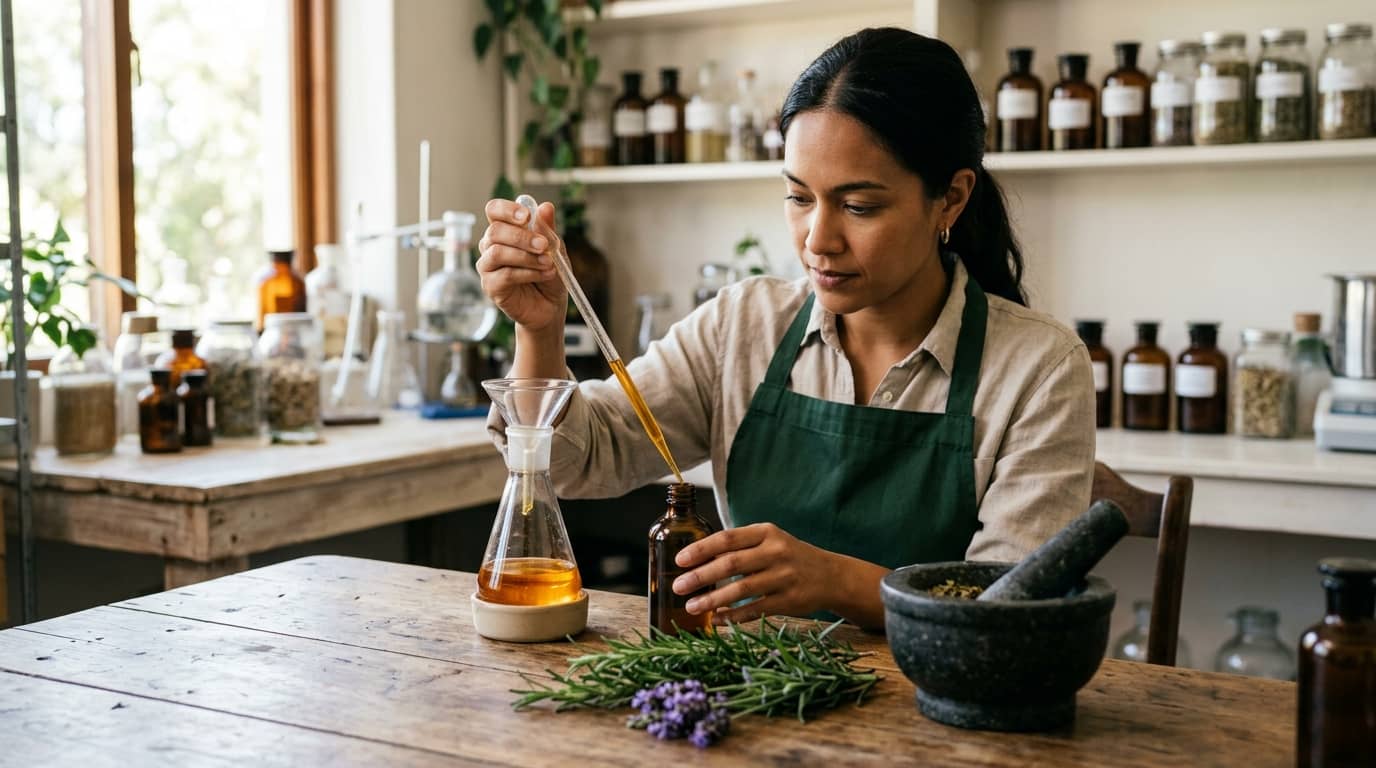
Medicinal and Aromatic Plants Course
Master the full spectrum of aromatic and medicinal plant science — from field identification and sustainable cultivation to extraction, formulation, and regulatory compliance. This comprehensive training gives you the technical knowledge and practical skills to work professionally with medicinal plants at every stage of the supply chain.
What you'll learn:
This training covers plant taxonomy, phytochemistry, and botanical identification so you can work with medicinal species accurately and safely. You will learn cultivation, harvesting, and post-harvest processing techniques that preserve the potency of plant material. Essential oil extraction methods, including steam distillation, CO2 extraction, and GC-MS analysis, are covered in depth. You will formulate a full range of herbal preparations and apply evidence-based therapeutic principles to client wellness protocols. The course also addresses herb-drug interactions, regulatory frameworks, good manufacturing practices, and commercialisation strategies for botanical products.
How you study in practice Medicinal and Aromatic Plants Course
How you practise Medicinal and Aromatic Plants Course
For businesses looking to train their team
With Elevify for businesses, the course includes exercises and examples tailored to your own business and the way your company needs.

Course content
8 Chapters • 40 LessonsDuration between 4 and 360 hours (you decide)
Chapter 1HideHide detailsSee detailsFoundations of Aromatic and Medicinal Plants
Foundations of Aromatic and Medicinal Plants
Lesson 1 • Plant Morphology and Identification
Covers vegetative and reproductive structures used to distinguish medicinal species. Connects morphological features to correct field identification.
Lesson 2 • Plant Taxonomy and Botanical Classification
Introduces binomial nomenclature and major plant families relevant to aromatics and medicine. Enables accurate identification and professional communication.
Lesson 3 • Introduction to Phytochemistry
Surveys primary and secondary metabolite classes found in medicinal plants. Links chemical families to therapeutic and aromatic properties.
Lesson 4 • History and Cultural Context of Plant Use
Traces medicinal plant use from ancient civilisations to modern phytotherapy. Establishes why historical knowledge informs contemporary practice.
Lesson 5 • Ecological Roles of Plant Compounds
Explains why plants produce bioactive compounds as ecological adaptations. Grounds phytochemical understanding in plant biology.
Chapter 2HideHide detailsSee detailsBotanical Identification and Field Skills
Botanical Identification and Field Skills
Lesson 1 • Voucher Specimens and Documentation
Covers collection, pressing, and labelling of voucher specimens for professional records. Ensures traceability and supports quality assurance in plant-based work.
Lesson 2 • Digital and Technology-Aided Identification
Introduces image-recognition apps, digital herbaria, and GPS-based plant databases. Positions technology as a supplement to, not replacement for, classical skills.
Lesson 3 • Field Identification Techniques
Teaches systematic observation protocols for identifying plants in natural habitats. Builds confidence in distinguishing medicinal species from toxic lookalikes.
Lesson 4 • Using Botanical Keys and References
Guides students through dichotomous keys and authoritative botanical references. Develops independent identification capability without reliance on single sources.
Lesson 5 • Safety and Toxic Plant Awareness
Identifies commonly confused toxic species and establishes safety protocols for field work. Prevents misidentification errors that could harm practitioners or clients.
Chapter 3HideHide detailsSee detailsCultivation and Sustainable Sourcing
Cultivation and Sustainable Sourcing
Lesson 1 • Propagation Methods
Covers seed germination, vegetative propagation, and tissue culture for medicinal species. Enables selection of the most efficient method per species.
Lesson 2 • Organic and Integrated Crop Management
Presents organic fertilisation, pest management, and crop rotation strategies. Ensures chemical residue-free plant material suitable for medicinal use.
Lesson 3 • Soil, Climate, and Site Requirements
Analyses soil chemistry, drainage, and microclimate factors that determine plant quality. Connects site selection to yield and phytochemical concentration.
Lesson 4 • Harvesting Timing and Techniques
Establishes optimal harvest windows based on phenological stage and active compound peaks. Directly impacts potency and shelf life of the final product.
Lesson 5 • Wild Harvesting and Conservation Ethics
Addresses sustainable wild-harvesting rules, at-risk species lists, and community consent. Aligns professional practice with conservation and ethical sourcing standards.
Chapter 4HideHide detailsSee detailsPost-Harvest Processing and Quality Control
Post-Harvest Processing and Quality Control
Lesson 1 • Good Agricultural and Collection Practices
Applies internationally recognised GACP frameworks to farm and wild-harvest operations. Ensures traceability from field to finished product.
Lesson 2 • Storage Conditions and Packaging
Defines temperature, humidity, light, and oxygen controls for long-term storage. Prevents degradation of volatile and heat-sensitive compounds.
Lesson 3 • Laboratory Quality Testing Methods
Introduces thin-layer chromatography, HPLC, and microbial testing for plant material. Connects lab results to safety and efficacy claims.
Lesson 4 • Drying and Dehydration Methods
Compares air drying, oven drying, freeze drying, and solar drying for different plant parts. Matches method to compound stability requirements.
Lesson 5 • Organoleptic and Physical Quality Assessment
Trains sensory evaluation of colour, aroma, texture, and moisture content. Provides rapid, low-cost quality screening before laboratory testing.
Chapter 5HideHide detailsSee detailsEssential Oil Extraction and Analysis
Essential Oil Extraction and Analysis
Lesson 1 • GC-MS Analysis and Oil Authentication
Teaches GC-MS chromatogram interpretation and adulteration detection for essential oils. Enables practitioners to verify oil identity and purity claims.
Lesson 2 • Cold Press and Solvent Extraction
Explains cold pressing for citrus oils and solvent extraction for absolutes and concretes. Addresses solvent residue concerns and quality implications.
Lesson 3 • Principles of Essential Oil Chemistry
Reviews terpene classes, functional groups, and volatility that define essential oil composition. Provides the chemical foundation for extraction and quality decisions.
Lesson 4 • Steam and Hydro-Distillation Techniques
Covers apparatus setup, operating parameters, and yield optimisation for distillation methods. Identifies which plant materials suit each distillation approach.
Lesson 5 • Supercritical CO2 Extraction
Introduces supercritical fluid extraction parameters and advantages over thermal methods. Positions CO2 extraction within premium and pharmaceutical-grade production.
Chapter 6HideHide detailsSee detailsHerbal Preparations and Formulation
Herbal Preparations and Formulation
Lesson 1 • Aqueous Preparations: Infusions and Decoctions
Covers water-based extraction ratios, temperature, and time for different plant parts. Establishes baseline formulation skills applicable to all preparation types.
Lesson 2 • Formulation Documentation and Stability Testing
Establishes batch records, SOPs, and accelerated stability protocols for herbal products. Ensures reproducibility and regulatory readiness of formulations.
Lesson 3 • Standardised Extracts and Dry Powders
Introduces spray drying, lyophilisation, and marker-compound standardisation. Bridges artisan formulation with pharmaceutical-grade production standards.
Lesson 4 • Topical Preparations: Oils, Salves, and Creams
Formulates infused oils, beeswax salves, and emulsified creams for external application. Connects carrier selection to skin absorption and stability.
Lesson 5 • Alcohol-Based Extractions and Tinctures
Details menstruum selection, maceration, and percolation for tincture production. Addresses alcohol concentration effects on compound solubility.
Chapter 7HideHide detailsSee detailsTherapeutic Applications and Evidence-Based Practice
Therapeutic Applications and Evidence-Based Practice
Lesson 1 • Herb-Drug Interactions and Contraindications
Identifies pharmacokinetic and pharmacodynamic herb-drug interactions and contraindicated populations. Enables safe integration of herbal and conventional therapies.
Lesson 2 • Evaluating Phytotherapy Research
Teaches critical appraisal of clinical trials, systematic reviews, and monographs for herbal medicine. Distinguishes high-quality evidence from anecdotal claims.
Lesson 3 • Dosage Principles and Administration Routes
Establishes dose-response relationships, therapeutic windows, and route-specific bioavailability. Prevents under-dosing and toxicity in professional practice.
Lesson 4 • Designing Client Wellness Protocols
Guides intake assessment, protocol design, and follow-up monitoring for individual clients. Integrates evidence, safety, and client-centred goals into actionable plans.
Lesson 5 • Major Therapeutic Categories and Key Plants
Maps leading medicinal plants to therapeutic categories including adaptogenic, antimicrobial, and anti-inflammatory. Builds a practical plant-action reference framework.
Chapter 8HideHide detailsSee detailsRegulatory Compliance and Product Development
Regulatory Compliance and Product Development
Lesson 1 • Product Dossier and Safety Assessment
Builds a product dossier including safety data, efficacy evidence, and stability results. Prepares students for regulatory submission and third-party audits.
Lesson 2 • Labelling Requirements and Claims
Covers mandatory label elements, permitted health claims, and prohibited disease claims. Prevents costly regulatory violations at the point of sale.
Lesson 3 • Good Manufacturing Practices for Botanicals
Applies GMP principles to botanical product facilities, equipment, and personnel. Ensures product safety, identity, strength, and purity at commercial scale.
Lesson 4 • Regulatory Categories for Plant Products
Distinguishes dietary supplements, cosmetics, traditional medicines, and food-grade plant products by regulatory definition. Determines compliance pathway before product development begins.
Lesson 5 • Market Entry and Commercialisation Strategy
Covers pricing, distribution channels, certification schemes, and brand positioning for botanical products. Connects compliance knowledge to viable business launch.

Your valid completion certificate
This course is for you:
Herbalist: wants scientific grounding to complement hands-on plant knowledge.
Wellness coach: seeks to integrate evidence-based herbal protocols into client work.
Entrepreneur: building a botanical product brand and needs compliance expertise.
Agronomist: expanding into medicinal crop cultivation and sustainable sourcing practices.
Career changer: transitioning from an unrelated field into the natural health industry.
Aromatherapist: ready to deepen chemistry and quality assessment knowledge professionally.
What our students say
Hear from those who've already studied with us:
Your lessons are perfect. I purchased the one-year package and finally have the opportunity to follow various topics of interest without needing to change platforms... I'm grateful for everything you do, I've already recommended you to other people...

I like how the lessons are straight to the point and how I can change chapters and skip content I don't need.

I like the content and the way videos are presented and transcribed, which speeds up the process!

The platform is fast and simple to use. The diversity of content and complementary videos really help with learning.

Top upskilling courses






FAQ
Who is Elevify? How does it work?
Do the courses have certificates?
Are the courses free?
What is the course workload?
What are the courses like?
How do the courses work?
What is the duration of the courses?
What is the cost or price of the courses?
What is an EAD or online course and how does it work?
PDF Course